
The 316th Block: Tech tourism and soft power
We need to pay more attention to prediction markets

This week…
Your reading time is about 5 minutes. Let’s start.
I need bots and cons to stop trying to scam me please. I really don’t believe you when you said last week’s edition was “exactly the kind of” content you’re looking for because it’s “lacking in mainstream media.” Really? I wonder why! I barely wrote anything original; I merely thematically curated the news of the week. 🙄 At least pick an edition where I actually wrote a whole article?
Anyway, I have a small assignment due in the next couple of weeks, then I will be writing the end-of-module essay assignment before my summer break from law studies. It won’t be due until early July, but I’m trying to get a headstart, especially while I’m still riding the high from the feedback from my previous assignment. So for the next month or so, TSB will be quite low-effort in output.
Conspiracy theory watch-list: Peter Thiel’s Argentina move is Nazi-ish
Your Wikipedia this week: Kardashian index
And now, a selection of top stories on my radar, a few personal recommendations, and the chart of the week.
ICYMI: The Previous Block was about samizdat, LinkedInese, and a cockroach.
CORRECTION NOTICE: None notified. MEDIA, TECH & REGULATION
China’s tech rise is creating a new kind of tourism
Kinling Lo for Rest of World:
For decades, the pilgrimage route for ambitious tech founders, investors, and engineers led to Silicon Valley. Now, a growing number of them are flying to Shanghai, Hangzhou, or Shenzhen instead.
China is seeing a surge in a new kind of tech tourism where visitors pay up to $9,000 for curated tours of electric-vehicle factories, robotaxis, and artificial intelligence and robotics companies. The trend is partially triggered by viral videos of China’s dancing humanoid robots and flying cars, creating a sense that the country may be moving faster than the West in key emerging technologies. As China-U.S. tech competition intensifies, these trips are also becoming a means to explore the next investment opportunity and tech breakthrough.
“There’s a fear-of-missing-out dynamic at play: the sense that China’s tech ecosystem has reached a level of sophistication where not seeing it firsthand puts you at an informational disadvantage relative to competitors who have,” Shaoyu Yuan, an international relations adjunct professor at New York University who specializes in China’s soft power, told Rest of World. “If you’re building a startup or making investment decisions, reading about BYDi’s vertical integration is one thing. Walking through the factory floor is another.”
Loosely linked:
The lure and lore of Southeast Asia: Understanding the dynamics of soft power by Irna Nurlina for Fulcrum.
Anthropic’s alliance with pope on AI harms: All in good faith or ‘Vatican-washing?’ by Sanya Mansoor for The Guardian.
The presiden who defied Trump: What will be Gustavo Petro’s legacy? by Roberto Andrés (tr. Jessica Sequeira) for The Dial.
Cómo medios comunitarios cultivan “huertas digitales” para reducir dependencia de las big tech por César López Linares en LJR.
Los influencers sustituyen a los críticos de cine: ¿“publicidad barata” o vía para atraer a gente joven? por Guillermo Martínez en elDiario.es.
On est les premiers au monde : une start-up française permet de vérifier l’âge des internautes grâce... aux mouvements de la main par Maxime Glorieux dans France Info.
J’étais candidat aux municipales et je me retrouve dans le bureau des légendes : comment LFI a été visée par une opération d’ingérence étrangère inédite par Valentin Stoquer dans France Info.
What I read, listen, and watch

I’m reading Newsroom Confidential (2022) by Margaret Sullivan. Unfortunately, I really should’ve followed my soft rule about not reading too much US-centred media. They just have a way to make everything so insufferable.
I’m watching the global manosphere, from Kenya to Mexico, on BBC’s Manosphere Messiahs.
I’m listening to On The Media on the Russian phrasebook for surviving authoritarianism. Someone please remind me when it comes out in September.
Chart of the week
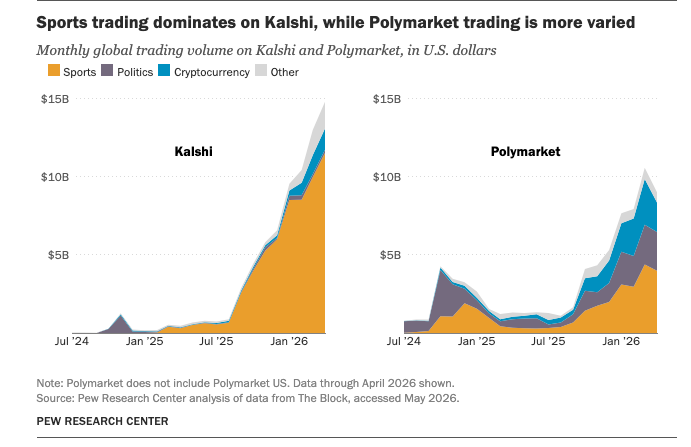
Trading volume on prediction markets has soared in recent months, according to Kaitlyn Radde and the Pew Research Center.