
The 315th Block: Samizdat, LinkedInese, and a cockroach
And war — what is it good for?

This week…
Your reading time is about 5 minutes. Let’s start.
Is it just me or does this platform no longer support the function to embed podcast? Anyway, I’m going to watch a documentary today. Bye!
Your Wikipedia this week: Salami slicing
And now, a selection of top stories on my radar, a few personal recommendations, and the chart of the week.
ICYMI: The Previous Block was about OSINT, prosthetics and human enhancements.
CORRECTION NOTICE: None notified. DISINFORMATION, MEDIA & JOURNALISM
The new samizdat
Natalia Antelava and Simon Allison for Coda:
While much of the media industry focused on the churn of headlines, we became increasingly interested in the undercurrents beneath them: the hidden systems, infrastructures and ideologies shaping events across borders and over time.
Again and again, our reporting led us back to the same realization: for a long time, the struggle over information was understood primarily as a question of censorship or access. Who controls information? Who gets to publish? Who gets silenced?
Those questions still matter. But they no longer fully describe the world we live in.
Today, the struggle over information is about who builds the systems through which reality is organized, distributed and trusted. From state propaganda to algorithmic feeds, from platform monopolies to AI-generated noise, the battle is not over facts. It is over the infrastructures that determine which narratives spread, which voices are amplified and which communities remain connected.
Loosely linked:
I started Cuba’s first independent magazine. Then my problems began by Abraham Jiménez Enoa (tr. Lily Meyer) for The Dial.
Breathing new life into the obituary — A new podcast uses one of journalism’s oldest forms to explore universal truths by Meg Dalton for CJR.
Los amigos y familiares de Mateo Pérez Rueda le rinden homenaje: “La guerrilla torturó y asesinó al periodista que vigilaba al poder en Yarumal” por Juan Miguel Hernández Bonilla en El País.
Orange pressée : le rescapé de France Télécom et la fabrique des suicides par Mathieu Deslandes dans La revue des médias.
DATA, AI & BIG TECH
The Filipino virtual assistants behind LinkedIn’s “thought leadership” content mill
Michael Beltran for Rest of World:
In the spring of 2025, the CEO of a European childcare startup posted a brief write-up about the qualities of a good leader on their LinkedIn page. Dozens of executives responded with comments like “Beautifully said,” “Leadership isn’t about titles. It’s about kindness,” and “Leadership is about action, influence, and integrity, not titles.”
LinkedIn is peppered with posts like these. But in this case, none of the executives were personally involved with the exchange. The posts and comments were produced by virtual assistants based in the Philippines, using generative artificial intelligence tools.
Rest of World spoke to six Filipino virtual assistants and two agencies who described a unique industry of low-paid and AI-assisted offshore workers producing content for executives and so-called thought leaders on LinkedIn. The names of the virtual assistants have been changed to protect their jobs. A LinkedIn representative told Rest of World the platform was attempting to crack down on this kind of behavior.
Loosely linked:
Pushing back from Big Tech: Africa’s hard road to AI sovereignty by Ananya Bhattacharya for Rest of World.
How armed groups in Colombia use social media to recruit children by Harriet Barber for New Lines Magazine.
El historiador que ha convertido el archivo de un pueblo manchego en un fenómeno en Instagram por Javier Muñoz de la Torre Granados en elDiario.es.
L’humain prononce de moins en moins de mots chaque jour par Alain Labelle dans Radio-Canada.
DEMOCRACY, RIGHTS & REGULATION
The untold mental trauma of living through the Malian war
Shola Lawal for Al Jazeera:
In the hot desert sun, hundreds of tents made of sticks and clothes spread out across a vast plain. Children run around barefooted in the sand, oblivious to their circumstances. In the shade of the huts, families gather around cups of hot tea, recounting stories of how they fled their homes in Mali, just on the other side of the border.
Mali is stuck in a deep crisis featuring multiple actors. Conflict is threatening to split the country into two. On one side is the Malian army and allied Russian mercenaries from the Africa Corps, which locals call by its previous name, Wagner. On the other side are armed groups linked to al-Qaeda and ISIL (ISIS) as well as separatist groups who have been fighting for an independent state of Azawad.
Much of the armed group activity is happening in northern Mali. It’s the same area where Tuareg separatists have long fought for autonomy, including during a 2012 crisis. The dominant armed group is the al-Qaeda-linked Jama'at Nusrat al-Islam wal-Muslimin (JNIM), which aims to control territory and impose religious law. It funds its operations by taxing locals and controlling illicit gold mines. Sometimes, JNIM partners with Azawad separatists to attack government positions.
Loosely linked:
India has a new political superstar — a cockroach by Zoya Mateen for BBC.
Silencing or strengthening? Ostracism and far-right radicalization of public figures. A mixed-method case study of a German civil rights activist by Katja Salomo for Nature.
Enfermos por Alejandra Sánchez Cabezas y Hugo Mercer en Revista Anfibia.
La techno-oligarchie est plus dangereuse que le fascisme historique par Anton Shekhovtsov dans Le Grand Continent.
What I read, listen, and watch

I’m reading Judgment at Tokyo (2023) by Gary J. Bass about the racist, hypocritical, and useless international criminal trial of WW2 Japanese military and political leaders. This book is the four times the average length of the books I normally read, so I’m in the second week of reading and digesting this book, which kind of parallels the longwindedness of the trial.
I’m listening to Tech Won’t Save Us on the prediction markets discourse.
I’m watching the Canadian premiere of The Brittney Griner Story (2026) this weekend.
Chart of the week
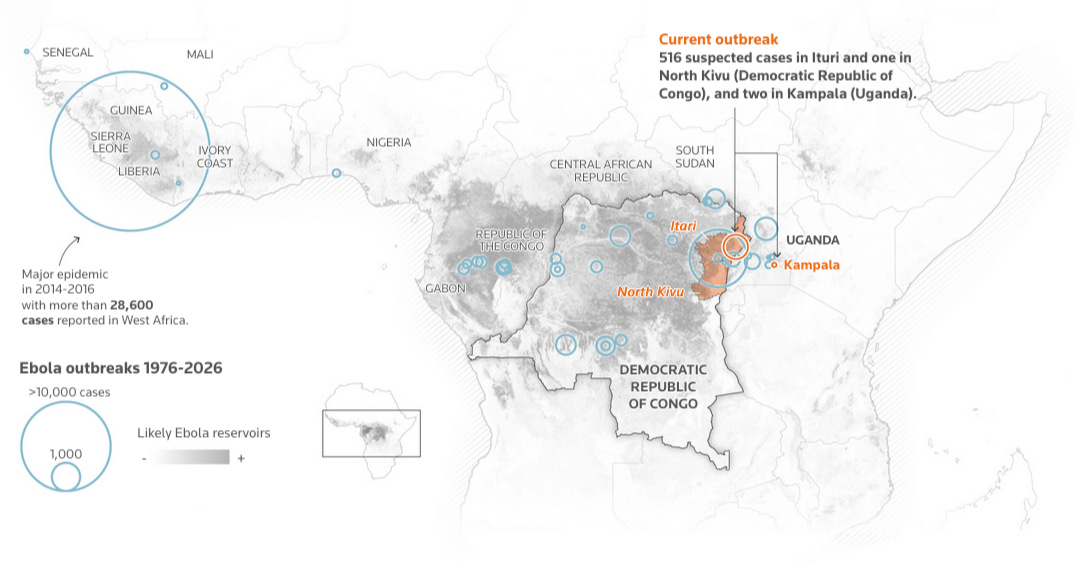
Anurag Rao and Mariano Zafra visualised the Ebola outbreak in central Africa for Reuters here.