
The 311th Block: Listen, here's the title
And the subtitle, ok. I didn't forget this time

This week…
Your reading time is about 5 minutes. Let’s start.
What do you think about Bigfoot? I had not given Bigfoot (or Sasquatch or Yeti) much thought recently until earlier this month, when I read about someone I know who, despite being a Bigfoot skeptic, is also critical of scientists who immediately dismiss Bigfoot reports without at least some examination. It struck me as a brazen conspiracist take from someone who is otherwise quite the opposite.
Many years later, I interviewed Hugo Leal, who studies the impact of digital technology on society, viral narratives, and misinformation at the University of Cambridge, for a miniseries I was producing on misinformation. I cannot remember if this made the cut, but he essentially said that there is a conspiracy theory for everyone — and if we start naming every possible one, even inventing a few new ones, something is going to stick with even the most “logical” and “rational” people. (See: The Barnum effect.) That was probably the last time I thought about George B. Schaller.
Until recently, of course. I came across a Mongabay piece by Rhett Ayers Butler that reviewed Miriam Horn’s book, Homesick for a World Unknown (2026), about Schaller’s career as a field biologist and conservationist. I have not read the book yet, but I intend to, because he is my father’s former colleague. (Okay, so I do not “know” him personally, but I have seen him since I was a kid, LOL.)

It was my father who first told me about Schaller’s views on Bigfoot, and I remember finding it difficult to accept. I was young, still in primary school, I think, and it felt like my scientific convictions, grounded in evidence-based inquiry, were being shaken to its very core. How dramatic. But later, I realised Schaller is probably right; if nobody considers Bigfoot sightings worthy of serious study, then who is collecting and examining evidence in the first place for us to to be able to make evidence-based decisions?
I had to come to that realisation on my own. But I think all those half-told stories and slightly unhinged ideas from my father were probably what helped honed my critical thinking skills because I kept having to come to a conclusion or decision myself. (Do you remember when I shared that he said social sciences are not a real science, so I decided to minor in anthropology and sociology at university? 😂)
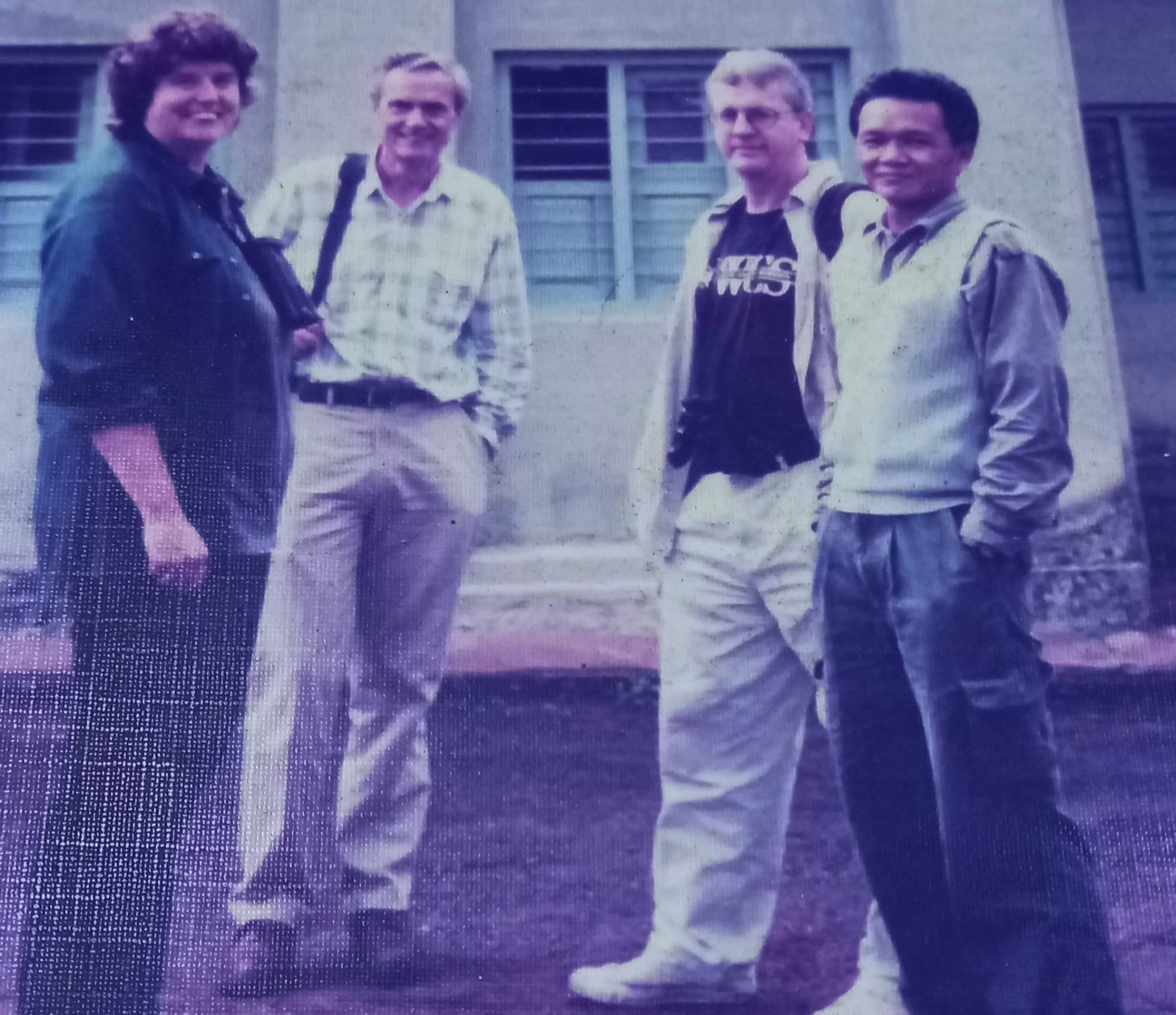
There are many other things I would argue about, or outright disagree on, with the four people in the photo above. For example, my father is more sympathetic towards eco-tourism, while I am… not (I am generally anti-any form of tourism). He does not consume game meat sustainably caught by villagers. (Just to be clear, I am not talking about endangered species, but common game like venison or wild fowl.) Instead, he sticks to captive-bred livestock, and this just seems wild to me still, because it sounds counterintuitive. That said, I also kind of get it. He did spend decades in wildlife conservation, after all. Also, do not ask him for his opinion on Jane Goodall, unless you’re ready for a controversial and polarising stance.
I am also much closer to June Rubis’ position on decolonising conservation — making it work from within Indigenous communities rather than around them. When she came in for her interview on BFM89.9’s Earth Matters, I did her pre-show brief, when she found out who my father was. She immediately recognised his name because he was one of the first Indigenous field biologists in our home state. 🥹
I think on a good day, my father would also agree with most of her positions, but sometimes he might feel feisty enough to play “devil’s advocate”. 🙄 But I also think that his doing so would not just be about blindly “defending” his colleagues — I think the three white people in the photo above did not go to the Global South with the explicit intent of neocolonisation, you know? I am sure they probably did see the world through a Western, maybe even “white savior” lens, but — at the risk of sounding like an apologist — I think they were sincere in their conservation efforts.
On a good day, I think my father would agree with most of her positions. On other days, he might feel feisty enough to play “devil’s advocate.” 🙄 But even then, I do not think it is about blindly defending his colleagues. I think the three white people in the photo did not go to the Global South with the explicit intent of neocolonisation. I am sure they saw the world through a Western, maybe even “white saviour” lens, but at the risk of sounding like an apologist, I do think they were sincere in their conservation efforts and have, over the many decades they’ve dedicated to their careers, likely continued to progressively evolve in their approaches. In fact, Mongabay also published an interview with Horn, the author, about writing the book. In it, are these paragraphs, which I felt are particularly relevant:
Here the biography broadens into a history of modern conservation. Schaller helped persuade governments to establish national parks and protected areas across Asia, Africa, and South America. The combined territory of these areas exceeds that of France. Horn is clear-eyed about the limits of this achievement. Protected areas did not always account for the needs of local people, and early conservation efforts often reflected colonial assumptions. Schaller himself evolved on this point. Through decades of fieldwork, he came to see that conservation could not succeed without local knowledge, participation, and authority.
Horn traces this shift carefully, showing how Schaller learned from Indigenous communities in Alaska, Africa, and Asia, and gradually moved toward a model of community-based conservation. This was not an ideological conversion so much as a pragmatic one, grounded in observation. Animals survived where people had reasons to protect them. The book avoids the temptation to retrofit modern language onto earlier work, but it makes clear that Schaller’s influence extended well beyond biology into the ethics and politics of conservation.
When I told my mother about the article on Schaller’s book and asked her to send me a photo of my father with Schaller, she also gave me a few updates on everyone: Bennett is now Vice President of Species Conservation at WCS, and Robinson was named an honorary member of IUCN in October last year.
Anyway, that Mongabay article stirred up a lot of nostalgia. I sometimes wish I had more opportunities to produce environmental stories, but most of my science journalism was in health and tech. I did get to contribute to Earth Matters a few times, including reporting from the UN climate convention and the Convention on Biological Diversity, where I met Sean Southey, then chair of the IUCN’s Commission on Education and Communication. He recruited me into the commission, of which I am still a proud member.
Your Wikipedia this week: Orang Pendek
Conspiracy watch-list: UFOs and missing scientists
And now, a selection of top stories on my radar, a few personal recommendations, and the chart of the week.
ICYMI: The Previous Block was about rice. I also figured out why my algorithm kept showing me rice content — my wife has been online shopping for a rice cooker for me. Anyway, I now have a brand new rice cooker. LOL.
CORRECTION NOTICE: I forgot to include the title AND subtitle to last week's edition. Well, it's about rice, in case you weren't sure.DISINFORMATION, MEDIA & JOURNALISM
Colombian journalism’s #MeToo moment: Hundreds of women speak out against a toxic and sexist culture
Beatriz Valdés Correa and Laura Dulce Romero for RISJ :
It all began with a small crack: an intern at Colombia’s most-watched news programme reported a journalist from Noticias Caracol of sexual harassment. A few days later, other women then came forward with complaints against another journalist at the same outlet.
The situation was made public on 20 March 2026 through a statement from the network. The organisation tried to protect the names of those accused in its statement, but within less than an hour their names were circulating on social media: Jorge Alfredo Vargas, the prime-time news anchor, and Ricardo Orrego, head of sports.
What no one anticipated was the domino effect that followed those complaints. In a country where impunity in sexual harassment and sexual abuse cases exceeds 90%, the complaints multiplied very quickly.
Complaints soon spread beyond Caracol: there were reports at El Espectador and El Tiempo, both top newspapers, and at the public broadcaster RTVC. And complaints were not only coming from interns. Well-known journalists published accounts of their experiences dating back more than ten years that they had not reported at the time, for fear of the consequences.
Loosely linked:
Brazil creates national standard for investigating crimes against journalists by Leonardo Coelho for LJR.
In article about horrific shooting, Forbes lets readers place bets by Maggie Harrison Dupré for Futurism.
El dilema de los hipopótamos en Colombia no es sólo una cuestión ética, es periodística por Silvia Higuera en LJR.
Vahid Online, le blogueur devenu « les yeux que nous n’avons plus » en Iran par Samuel Hauraix dans La revue des médias.
DATA, AI & BIG TECH
Peter Thiel is building a parallel justice system powered by AI
Nic Dawes for Coda:
In 2016, when Peter Thiel killed Gawker, he insisted that he wasn’t attacking journalism writ large.
On the contrary, he told the New York Times, he’d spent $10 million secretly backing Hulk Hogan’s lawsuit against the news outlet because: “I saw Gawker pioneer a unique and incredibly damaging way of getting attention by bullying people even when there was no connection with the public interest… if I didn’t think Gawker was unique, I wouldn’t have done any of this. If the entire media was more or less like this, this would be like trying to boil the ocean.”
10 years later with the aid of an “AI tribunal,” a team of intelligence and law enforcement veterans, and a political climate vastly more hostile to press freedom, he is trying to do exactly that, bypassing the courts, short-circuiting the first amendment, and making it much, much cheaper to indulge in the quasi legal harassment of journalists.
Peter Thiel funds objection.ai, cofounded by Aron D’Souza, who worked closely with him on the Gawker case. Loosely linked:
AI is a double-edged sword for Indigenous stewardship, say U.N. experts by Aimee Gabay for Mongabay.
‘Fullz’, ‘clicking’ and ‘addys’: how teens talk about fraud by Hilary Osborne for The Guardian.
Los centros de datos: El calor detrás de la nube por Gabriel Farias y Miguel Dobrich en Amenaza Roboto.
Sexisme algorithmique : comment nos IA exacerbent les inégalités par Emilie Echaroux dans Usbek & Rica.
DEMOCRACY, RIGHTS & REGULATION
When private equity meets global development: How one fund wreaked havoc on Kenya’s health care system
Hettie O’Brien for The Dial:
The term “global development” might conjure images of charities staffed by well-meaning aid workers. In fact, much of the money in global development is managed by “development finance institutions” (DFIs), secretive government-owned organizations that spend taxpayer dollars and work closely with financiers and private equity funds. These have been criticized in the past for interpreting “development” to mean whatever they want it to mean. In 2014, Britain’s own example, the Commonwealth Development Corporation (CDC), invested taxpayer funds into an “aspirational ocean lifestyle village” in Mauritius, gated communities in El Salvador and two luxurious hotels in Nigeria, including one in Lagos where rooms started at $400 a night. It had also invested in private schools in sub-Saharan Africa, and the Dubai-owned parent company of P&O Ferries, which sacked its British workers and replaced them with foreign staff who were reportedly paid £1.82 an hour. (A spokesperson from the CDC told me that highlighting these investments would be “highly misleading” since they were “historic,” even though the organization had invested in P&O’s parent company only four years earlier.)
Loosely linked:
An endless purgatory: How an exiled Iranian waits and watches by Mark Sigetty Bøje for Coda.
Preparing for an invasion — Taiwan goes it alone by Michelle Kuo for The Dial.
Malvinas bajo la Doctrina Donroe por Lucca Conte Giannetti en Anfibia.
Russie, narcotrafic, darknet... Plongée dans les coulisses du très discret service espion des douanes françaises par Hugo Puffeney dans Franceinfo.
What I read, listen, and watch
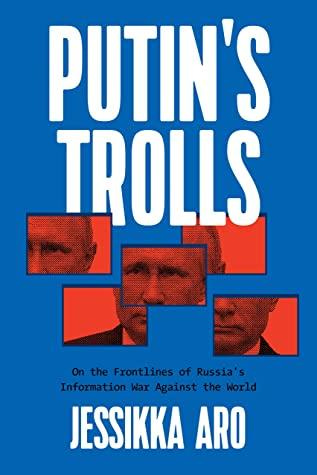
I’m reading Putin’s Trolls (2021) by Jessikka Aro. It’s probably my first time reading in-depth about Russia’s infomation war from a non-U.S. perspective. It’s particularly important to note that the author is a Finnish investigative reporter.
I’m listening to Tech Won’t Save Us discussing how tech reporters coupled with corporate interests are irresponsibly boosting the profile of tech CEOs, damaging public trust in journalism.
I’m watching a DW documentary on journalists who spy for the secret service.
Chart of the week
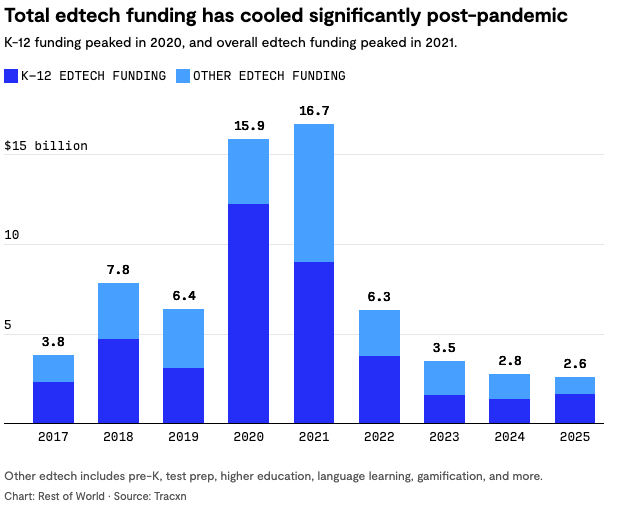
The global edtech boom is fading, according to data from Tracxn, as reported by Ananya Bhattacharya for Rest of World. Sweden is going as far as returning to physical books and pen-and-paper teaching to “reverse falling literacy levels,” as BBC’s Maddy Savage earlier reported.
Back to back bangers!