
The 301st Block: Democracy in shambles online and in real life (sad)
Patterns and meanings

This week…
Your reading time is about 5 minutes. Let’s start.
The time has come, friends. I will take a short break, and there will not be an issue out next week. Maybe. I am hosting a Lunar New Year dinner and doing all the cooking all weekend. So I could be quite busy and won’t have time to curate the next edition. Maybe. TSB will be back Februar 22.
Anyway, in case you’re interested in what I’m observing in the coming week: The buzz on my social media algorithm is the conspiracy theory that since US withdrew from the WHO, scientists from around the world are no longer shackled by US agencies who are gatekeeping cures and therapies for profit; and are instead announcing breakthroughs for expensive diseases at lightning speed. (Please read the Wikipedia of the week.)
Your Wikipedia this week: Apophenia
And now, a selection of top stories on my radar, a few personal recommendations, and the chart of the week.
ICYMI: The Previous Block was about exiled journalists, dead tech workers, and scammed soldiers.
CORRECTION NOTICE: None notified.DISINFORMATION, MEDIA & JOURNALISM
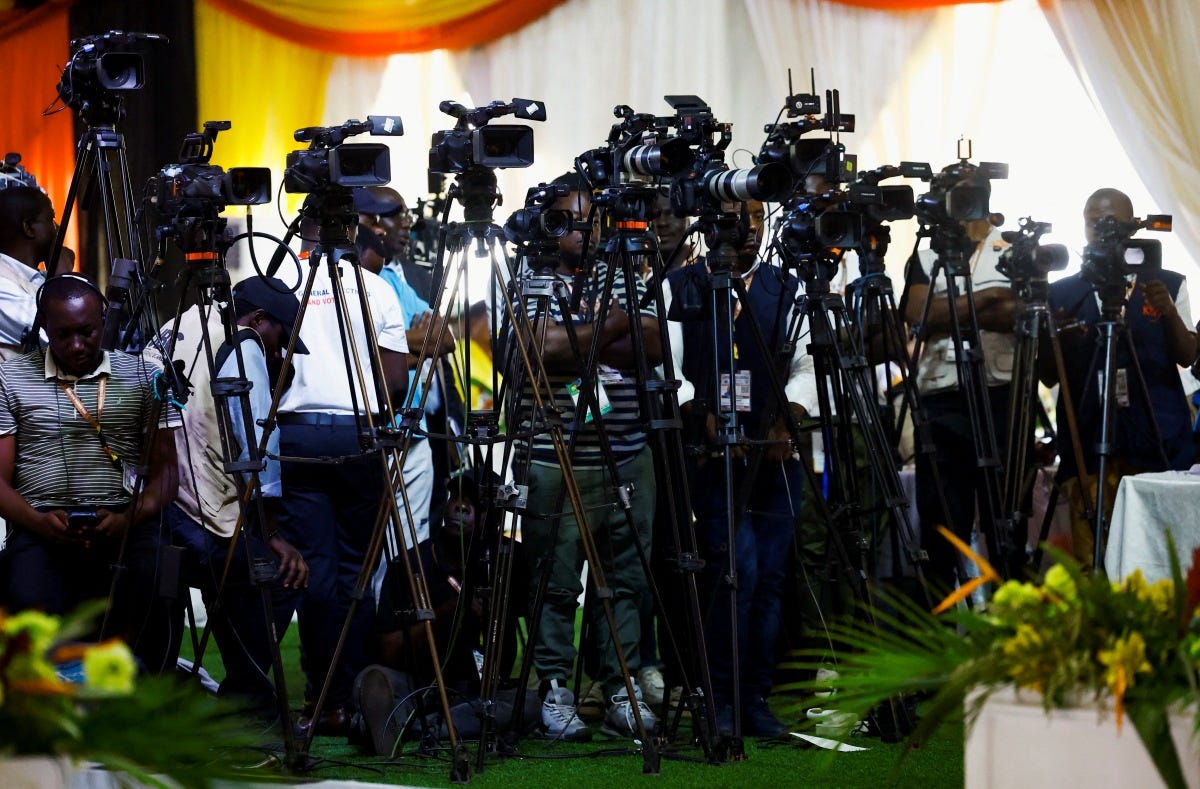
How Ugandan reporters managed to cover the latest election despite a climate of fear
Maurice Oniang’o for RISJ:
When Ugandans went to the polls on 15 January, the nation’s journalists faced a trial by fire. The country’s President, Yoweri Museveni, who has ruled for nearly four decades, was seeking another term at age 81. He was declared the winner a few days after the vote.
Two days before the election, citing the need to curb “misinformation, disinformation, electoral fraud and related risks,” the government shut down the nation’s internet access. Journalists faced escalating threats from security forces, while newsrooms operated under strict censorship guidelines that dictated what could and could not be reported.
Ruth Adong, content lead for the Good Morning Africa podcast and head of the business desk at Sanyu FM, a popular urban radio station that has broadcast for over 30 years, recalled a time when journalists could find shelter behind police lines if a situation turned volatile.
“There was an understanding that we were there to put out a story,” she said. By this year, that understanding had evaporated. Now the police were often the ones seizing equipment or beating reporters, and the directive from editors was starkly different: “If things get dicey, get out of there.”
For Adong and hundreds of reporters across the country, the internet blackout was a weapon that crippled verification and cut journalists off from editors, sources, and publishing systems.
Loosely linked:
Latin America is dotted with news deserts. These are the reporters filling the void by Gretel Kahn for RISJ.
When celebrity gossip becomes political messaging by Leonardo Coelho for LJR.
Milei crea una oficina especial para “desenmascarar mentiras y operaciones de los medios” por Javier Lorca en El País.
« C’est très dur de lâcher » : ces enquêtes auxquelles les journalistes doivent renoncer par Clara Lainé dans La revue des médias.
DATA, AI & BIG TECH
The volunteer Wikipedia army protecting against AI slop
Ananya Bhattacharya for Rest of World:
As Wikipedia takes on a critical role in shaping artificial intelligence tools, its content moderators are feeling the pressure and responsibility of their task.
On January 15, Wikimedia Foundation — the nonprofit that runs Wikipedia — announced a string of partnerships with major AI companies, including Amazon, Meta, Microsoft, Mistral AI, and Perplexity, “to integrate human-governed knowledge into their platforms at scale.” The large language models of these AI giants will now gain access to information across several Wikimedia projects, including free encyclopedias in 350 languages, Wikibooks in 75 languages, and the Wiktionary in more than 190 languages.
Regional-language Wikipedia editors now find themselves doing double duty: feeding AI systems with credible knowledge while also guarding their languages against AI-generated misinformation and low-quality content. Their work could determine how well billions of people can access accurate AI in their own languages.
Loosely linked:
AI-generated wildlife photos make conservation more difficult by Rhett Ayers Butler for Mongabay.
Resistance blooms in Mexico’s data centre valley by Diana Baptista and Fintan McDonnell for Context.
Los tecnoligarcas reaccionan con bulos e insultos a la propuesta de regulación de Sánchez por Carlos del Castillo en elDiario.es.
Voici comment vos artistes préférés manipulent les palmarès par Daniel Blanchette Pelletier dans Radio-Canada.
DEMOCRACY, RIGHTS & REGULATION
How MAGA-inspired politics are reshaping Japan and South Korea
Eleonora Zocca for New Lines Magazine:
On Feb. 8, Japan will head to the polls after Prime Minister Sanae Takaichi dissolved the lower house of parliament and called for snap elections, aiming to capitalize on her high approval ratings. The first woman to hold her office in a country where significant gender gaps persist, particularly in politics — notably without coming from a family of politicians — she has earned widespread support through her direct, less rigid approach. Her gamble is to use this momentum to secure a more substantial majority than the current one-seat margin held in coalition with the right-wing populist Japan Innovation Party.
Yet despite polls placing Takaichi’s support rate at 60%, it is not guaranteed that this personal popularity will translate into equally strong backing for the Liberal Democratic Party (LDP) as a whole. Japan’s political terrain is being redefined by a brand of populism that bears a distinct American imprint — a phenomenon that is no longer an anomaly but a regional trend. One of the most compelling barometers of this election will be the performance of Sanseito, the far-right, xenophobic party that has sparked intense debate. Yet to fully grasp the “MAGAfication” of the region’s politics, one must look beyond Japan’s borders toward neighboring South Korea.
Loosely linked:
Always on the outside: Exile isn’t about the country you leave by Garry Pierre-Pierre for Coda.
How Substack makes money from hosting Nazi newsletters by Geraldine McKelvie for The Guardian.
Francesca Albanese: “Las democracias liberales se dirigen hacia el modelo israelí, con vigilancia, control y exclusión” por Olga Rodríguez en elDiario.es.
Influencer les populations pour qu’elles s’allient à notre cause : à Nancy, des étudiants s’entraînent à la cyberguerre par Noémie Bonnin dans Franceinfo.
What I read, listen, and watch
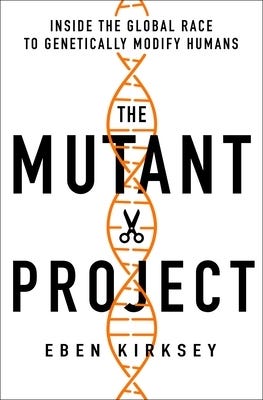
I’m reading The Mutant Project (2020) by Eben Kirskey. It is a little unfortunate how quickly books become dated when discussing fast-moving technologies like genetic modifications. But the historical context and the basis of the science explored in this book still stand.
I’m listening to Citations Needed on the history of the panic around unsanctioned flow of information.
I’m watching Al Jazeera’s documentary on Japan’s loneliness crisis.
Chart of the week
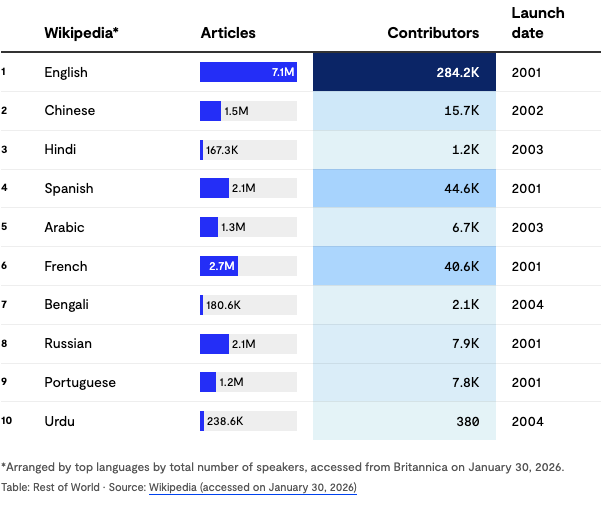
Wikipedias in the world’s most widely spoken languages, from the second story above, courtesy of Rest of World with data from Wikipedia (January 30, 2026).