
The 299th Block: Displacement, Africa's internet, and diaspora politics
Watched Borgen, yet?

This week…
Your reading time is about 5 minutes. Let’s start.
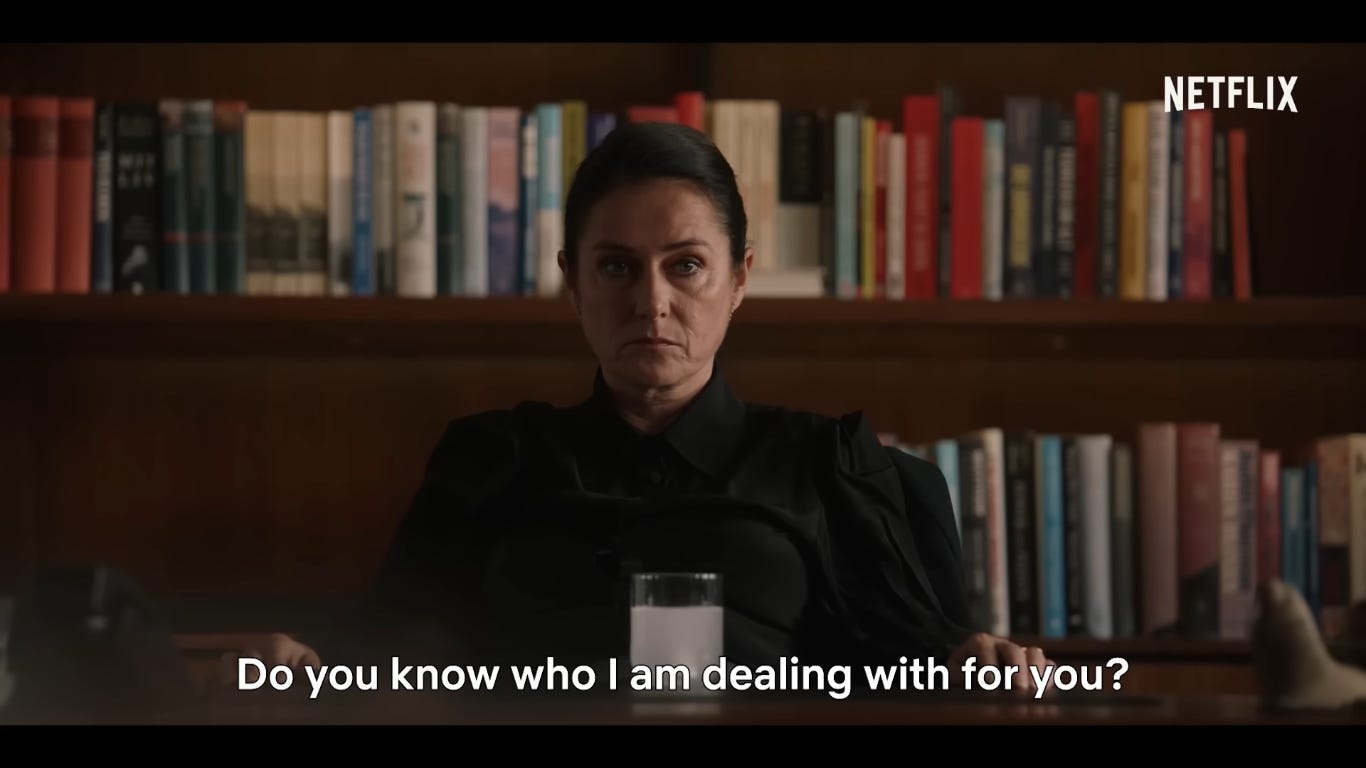

Borgen has never been more relevant. You just have to watch it.
Your Wikipedia this week: Cartographic propaganda
And now, a selection of top stories on my radar, a few personal recommendations, and the chart of the week.
ICYMI: The Previous Block was about RISJ’s journalism prediction, an untouchable hacker god, and the foreigners lured into the Russian army.
CORRECTION NOTICE: None notified.DISINFORMATION, MEDIA & JOURNALISM
My journey from foreign correspondent to Uber driver in Trump’s America
Steve Scherer on Substack:
For several years I covered the deadliest migration route in the world, across the Mediterranean to Italy from Libya or Tunisia. Some 26,000 migrants are estimated to have died attempting this sea passage since 2014, a number roughly equivalent to half of America’s dead in the Vietnam War. It is also where there have been the most disappearances. Only Neptune, Roman god of the sea, knows how many.
At the time I was documenting the contours of human displacement I didn’t really understand what would drive a person to attempt such a dangerous passage, especially with children in tow. Now I am closer to understanding that kind of desperation.
Loosely linked:
A grenade under her pillow?: the Filipino journalist jailed for six years without trial by Tess McClure for The Guardian.
A newsroom in exile imagine a free Kurdish press by Seyma Bayram for CJR.
A battle over donations in French journalism by Marine Doux for CJR.
Forest journalists are reimagining how stories from the Amazon are told by Leonardo Coelho for LJR.
Abelardo de la Espriella redobla su ofensiva contra los periodistas que investigan su relación con Álex Saab por Santiago Torrado y Diego Stacey en El País.
Retarder la publication d’informations sensibles ? Le dilemme des journalistes défense par Tom Sallembien dans La revue des médias.
DATA, AI & BIG TECH
Big Tech is racing to own Africa’s internet
Damilare Dosunmu for Rest of World:
“Africa remains the least-connected region in the world, yet this is precisely what makes it one of the most attractive markets for global connectivity providers,” Temidayo Oniosun, founder and managing director at consulting firm Space in Africa, told Rest of World. “The scale of unmet demand means that virtually every major player sees Africa as a strategic growth market.”
Nigeria, as the most populous country on the continent, carries particular symbolic and commercial weight, Oniosun said.
In contrast to Europe and North America, where connectivity is well distributed, Africa still offers hundreds of millions of potential first-time users. Only about 38% of Africans were online in 2024, according to the International Telecommunication Union. This leaves more than 400 million people without internet access. Even where networks exist, usage remains constrained by high costs and poor service quality. Mobile broadband penetration in sub-Saharan Africa remains below 50%, while fixed broadband access is limited largely to major cities.
Control of infrastructure — not consumer apps — has become the strategic priority, Oniosun said.
That race is also playing out under the sea.
Loosely linked:
When evidence can be deepfaked, how do courts decide what’s real? by Linda Besner for The Walrus.
Experts warn of threat to democracy from AI bot swarms infesting social media by Robert Booth for The Guardian.
OpenAI will put ads in ChatGPT. This opens a new door for dangerous influence by Raffaele F Ciriello (University of Sydney) and Kathryn Backholer (Deakin University) for The Conversation.
AI evangelist Mikey Shulman says he’s making pop, not slop by Eamonn Forde for The Guardian.
El algoritmo y los periodistas (y Yoko Ono) por Xosé Manuel Pereiro en CTXT.
L’insaisissable escroc aux sentiments fait de nouvelles victimes par Laetitia Cherel dans Franceinfo.
DEMOCRACY, RIGHTS & REGULATION
Iran’s protest movement and diaspora politics
Kourosh Ziabari for New Lines Magazine:
“Enough is enough.”
Despair and exhaustion coursed through the voice of Narges, an English teacher in a small town in the west of Guilan province, as she was leaving me recorded messages on Instagram. She was one of the only four people in Iran who received and could reply to my notes in the middle of a crippling internet shutdown, which the government introduced on Jan. 8 to extinguish the flames of an epic uprising.
The 35-year-old had participated in anti-government protests that started on Dec. 28 and was in constant communication with friends who were also joining the movement in other cities. A physician friend of hers in Rasht told her that in only one day, nearly 30 dead bodies were brought into the hospital where they worked.
As disillusionment starts to set in following a deadly crackdown that stamped out the uprising, everyone is feeling “unhappy, dissatisfied and angry,” she told me, which is why people are not revolting. It wasn’t only brute force that was deployed to silence the protesters. The internet blackout was a tormenting way of confining people to darkness.
Loosely linked:
From Iran to Uganda, internet shutdowns batter economies by Kim Harrisberg for Context.
Ethiopia’s digital blackouts are an attempt to turn off accountability by Aemro Worku Ayalew for LSE Blog.
From Uganda to Cameroon, how Africa’s ‘leaders for life’ stay in power by Shola Lawal for Al Jazeera.
Vietnam’s post-war generation takes the helm by Nguyen Khac Giang for Fulcrum.
Bangladesh’s latest election battlegrounds: TikTok, Facebook, YouTube by Moudud Ahmmed Sujan for Al Jazeera.
La caída de las llegadas irregulares de migrantes a España y Europa desmonta el discurso alarmista de PP y Vox por Gabriela Sánchez en elDiario.es.
Influence, espionnage... L’Église orthodoxe russe, cheval de Troie de Moscou en Suède par Sébastian Seibt et Louise Nordstrom dans France 24.
What I read, listen, and watch
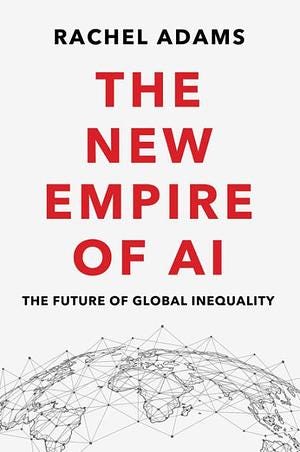
I’m reading The New Empire of AI (2024) by Rachel Adams. A little bit of an African perspective in the geopolitics of AI, and that’s always a good thing.
I’m listening to the 404 Media Podcast on how Wikipedia will survive AI.
I’m watching a DW documentary about Greenland.
Chart of the week
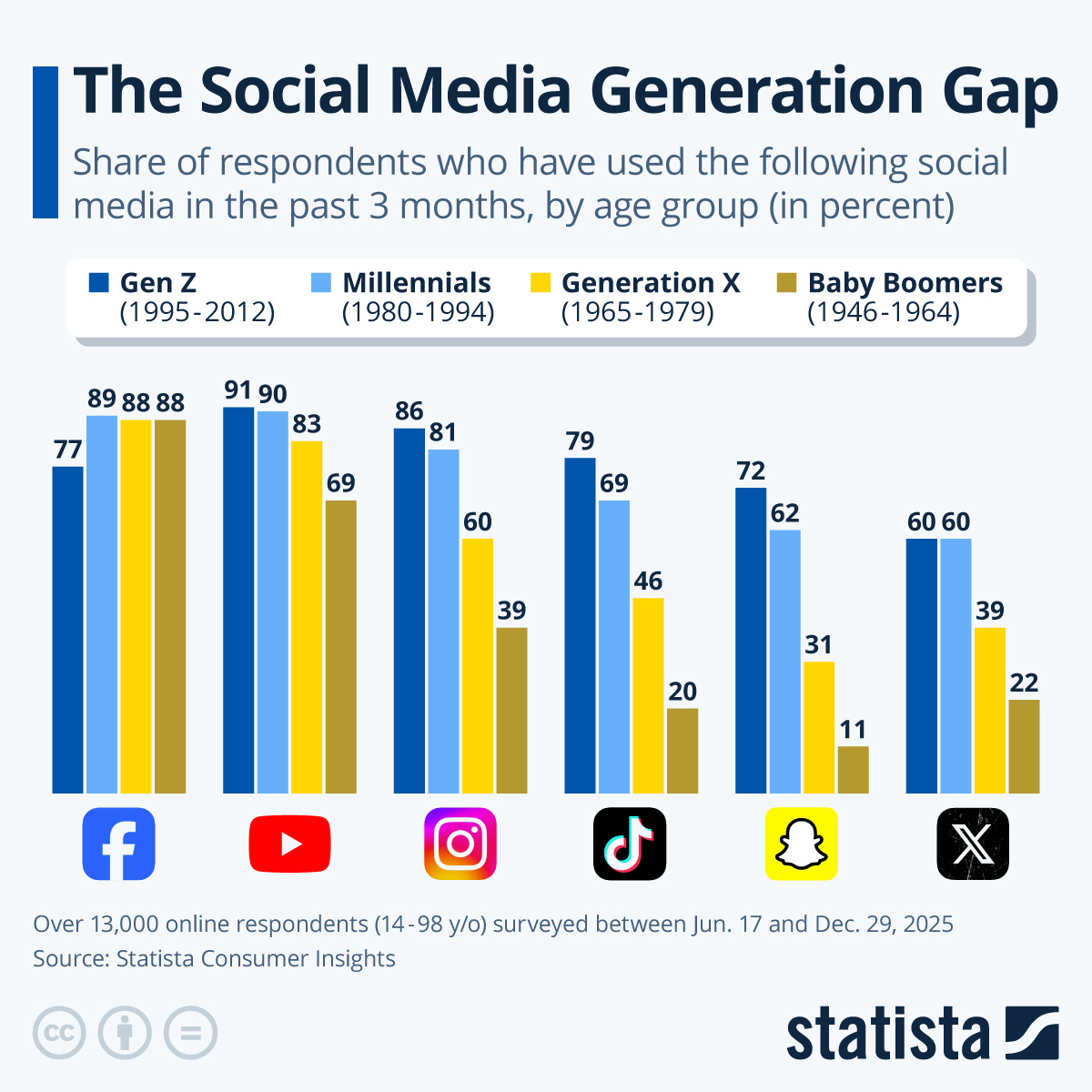
A new study from Statista Consumer Insights reveals how differently generations engage with social media, reports Tristan Gaudiaut. No surprises, I think.
Borgen is really good!!!