
The 297th Block: Breaking the information blockade in Venezuela
Plus, facial recognition for Indian pensioners and digital citizen score for Vietnamese

This week…
Your reading time is about 5 minutes. Let’s start.
Elections of varying degrees of legitimacy will be happening this year. Some to look out forward to include:
Myanmar’s general election throughout January
Uganda’s general election, January 15
Portugal’s presidential election, January 18
Thailand’s general election, February 8
Bangladesh’s general election, February 1 - its first since the Gen Z uprising that led to the ouster of then-prime minister Sheikh Hasina. Economist Muhammad Yunus currently leads the interim government as chief adviser.
Nepal’s general election, March 5 - Gen Z protests forcing then-prime minister KP Sharma Oli’s resignation. Former chief justice of the Supreme Court of Nepal Sushila Karki was voted interim prime minister, after a Discord poll.
Vietnam’s parliamentary election, March 15
Republic of Congo’s presidential election, March 22
Hungary’s parliamentary election, April
Libya’s presidential and parliamentary elections, April
Colombia’s residential election, May 31
Lebanon’s parliamentary election, May
Algeria’s parliamentary election, by June
Zambia’s general election, August 13
Sweden’s general elections, September 13
Morocco’s parliamentary election, September
Russia’s parliamentary election, September
Brazil’s general election, October 4
Israel’s parliamentary election, October 27
Denmark’s general election, by October 31
New Zealand’s general election, by December 19
South Sudan’s general election, December 22
Your Wikipedia this week: Is this the most useless election?
And now, a selection of top stories on my radar, a few personal recommendations, and the chart of the week.
ICYMI: The Previous Block was about bringing the news to the frontlines, scammer’s guide to scamming, and how war affect children’s brain.
CORRECTION NOTICE: None notified. DISINFORMATION, MEDIA & JOURNALISM
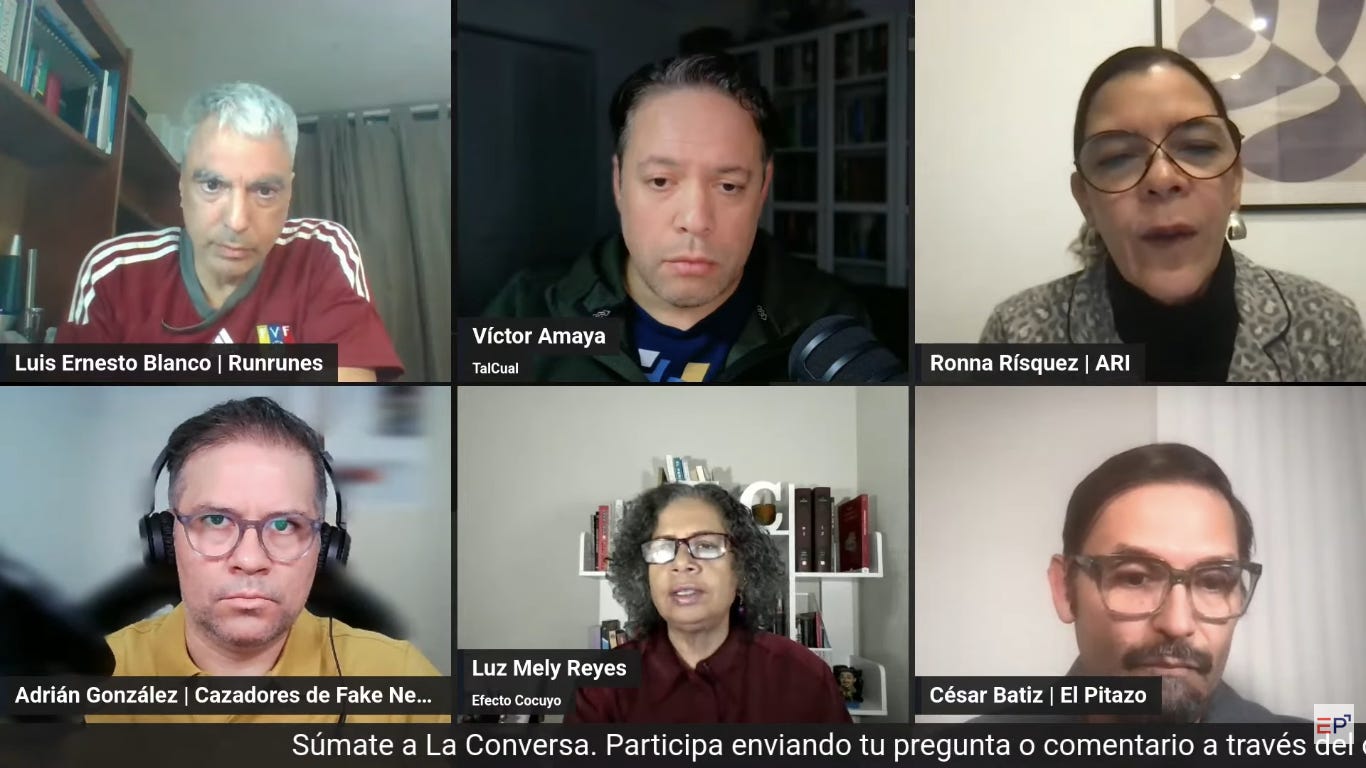
How Venezuelan journalists broke the information blockade with a 10-hour broadcast of Maduro’s ouster
César López Linares, translated by Teresa Mioli, for LJR:
It was around 2:00 a.m. on Jan. 3 when reports of explosions and low-flying aircraft in the city of Caracas began circulating on social media.
Luz Mely Reyes, a Venezuelan journalist in exile and director of the digital media outlet Efecto Cocuyo, quickly learned what was happening. She contacted a group of colleagues, also in exile, via text message, and within minutes they organized a live broadcast to inform their compatriots about what was going on in Venezuela.
Initially, in addition to Reyes, the participants included César Batiz, director of the digital media outlet El Pitazo; Luis Ernesto Blanco, from Runrun.es; and Víctor Amaya, from TalCual; coordinated by Ronna Rísquez, from the network of independent Venezuelan media outlets Alianza Rebelde Investiga (Rebel Alliance Investigates). Throughout the broadcast, others joined, including exiled journalist César Miguel Rondón.
“In the early hours of Jan. 3, a colleague of mine told me, ‘There are bombings in Caracas,’ and we all sprang into action in the small virtual newsroom we have,” Reyes told LJR. “Those of us who were awake immediately decided, ‘Let’s go on the air,’ and we started the broadcast, which was historic.”
What began as a live stream to report on the explosions in Caracas turned into a 10-hour and 48-minute broadcast that reported, explained and verified step by step the military operation that ended in the capture and transfer to the United States of the Chavista leader Nicolás Maduro, who until that moment had governed Venezuela for more than 12 years.
Lee en español aquí. Loosely linked:
Venezuela detains journalists and seizes communication devices after Maduro’s removal by Sibylla Brodzinsky for The Guardian.
How Russia’s influence machine mobilised immediately after Maduro’s capture by Eto Buziashvili for DFRLab.
China’s growing media footprint in Indonesia by Dalia Parete for Lingua Sinica.
El calvario de los periodistas en la República del Congo: “La libertad de prensa es condicional. Algunos temas se toleran y otros mucho menos” por Nalovo Akua en El País.
Présidentielle en Ouganda: journalistes sous pression, entre violences, autocensure et guerre numérique par Christina Okello dans RFI.
DATA, AI & BIG TECH
No match: Rajasthan’s push for facial authentication on pensioners leaves many behind
Anumeha Yadav for The Wire:
Ghisi Devi, of Vijaypura village in Rajsamand district’s Deogarh panchayat, turned 70 years old in 2006, says her voter ID card. That would make her just short of 90 years old today. A paper card bearing the details of her Aadhaar – her biometrics-linked ID number – however, records her as 92 years old. It states she was born on January 1, 1933, over a decade before India became independent from British colonial rule.
On a crisp November noon, Devi, who worked on a farm all her life but has been bedridden for the last year, tried to sit up on her cot covered with blankets. A local community activist was trying to carry out her facial authentication on a mobile device. Her room was bare, with a chakki or millstone to grind flour by hand in a corner, and a handful of metal pots and plastic cans on bare shelves. It was dark inside, though the noon sun shone bright outside.
Nikesh Kumar, the activist, asked Devi in Marwari to blink her eyes at the screen of the mobile phone he held up in his hands. But she is hard of hearing, and could not follow what he said. She looked warily towards the phone camera. The screen showed her face encircled with a green line that would turn red every few seconds, implying a failed attempt. This went on for several minutes. The activists and her family members gathered around her repeated — louder each time — that she must blink to get her pensions. Devi got increasingly irritated and finally, gestured that everyone should leave the room.
Loosely linked:
Grok turns off image generator for most users after outcry over sexualised AI imagery by Helena Horton, Dan Milmo and Amelia Gentleman for The Guardian.
A red pixel in the snow: How AI solved the mystery of a missing mountaineer by Vedrana Simičević for BBC.
The AI race is creating a new world order by Nick Srnicek for Rest of World.
Engaños de la IA: cuando aporta fuentes reales pero inventa su contenido por José Luis González-Geraldo en The Conversation.
Digital Omnibus : l’Europe est-elle en train de détricoter sa propre souveraineté numérique ? par Ludovic Chauvaux dans Usbek & Rica.
DEMOCRACY, RIGHTS & REGULATION
Beyond the points: Vietnam’s digital citizen score is about power
Dien Nguyen An Luong for Fulcrum:
Use an online public service, earn points. Book a medical appointment digitally, earn points. Submit feedback on a draft regulation, earn points. Log in regularly, update your data, transact online, earn more points. Accumulate enough, qualify for fee waivers, tax discounts, and faster access to public services.
So reads Vietnam’s proposed “digital citizen score”, embedded in VNeID, the government’s national digital identification application.
Officials insist the system carries no penalties, with non-participation framed as simply forgoing the rewards. This logic underpins the new initiative, which takes the form of a draft government resolution spearheaded by the Ministry of Public Security, outlining a national framework for promoting digital citizenship through incentives linked to platform use. The resolution creates a simple hierarchy: citizens who use digital services more often receive more benefits. Instead of one-off incentives, participation is tracked over time and translated into tiered status. Because activity is counted across multiple services, digital participation becomes a standing condition of how citizens interact with government, not just an optional add-on.
If you find this similar to China’s “social credit system,” you might like to read on — the author will fill you in on the deviation. Unrelated:
The Identitarians are back: How a discredited worldview dominates the global agenda by Josephine Lulame for Coda.
Environmental crime prevention is moving into the diplomatic mainstream by Robert Muggah for Mongabay.
‘There wasn’t even time for CPR’: Iran medics describe hospitals overwhelmed with dead and injured protesters by Soroush Pakzad, Roja Assadi and Helen Sullivan for BBC.
Venezuela attack, Greenland threats and Gaza assault mark the collapse of international legal order by Jorge H. Sanchez-Perez for The Conversation.
Taiwán no es Venezuela por Félix Valdivieso en The Conversation.
Au Japon, le sanctuaire Yasukuni entre patriotisme et négationnisme par Maxence Marius dans MIR.
What I read, listen, and watch
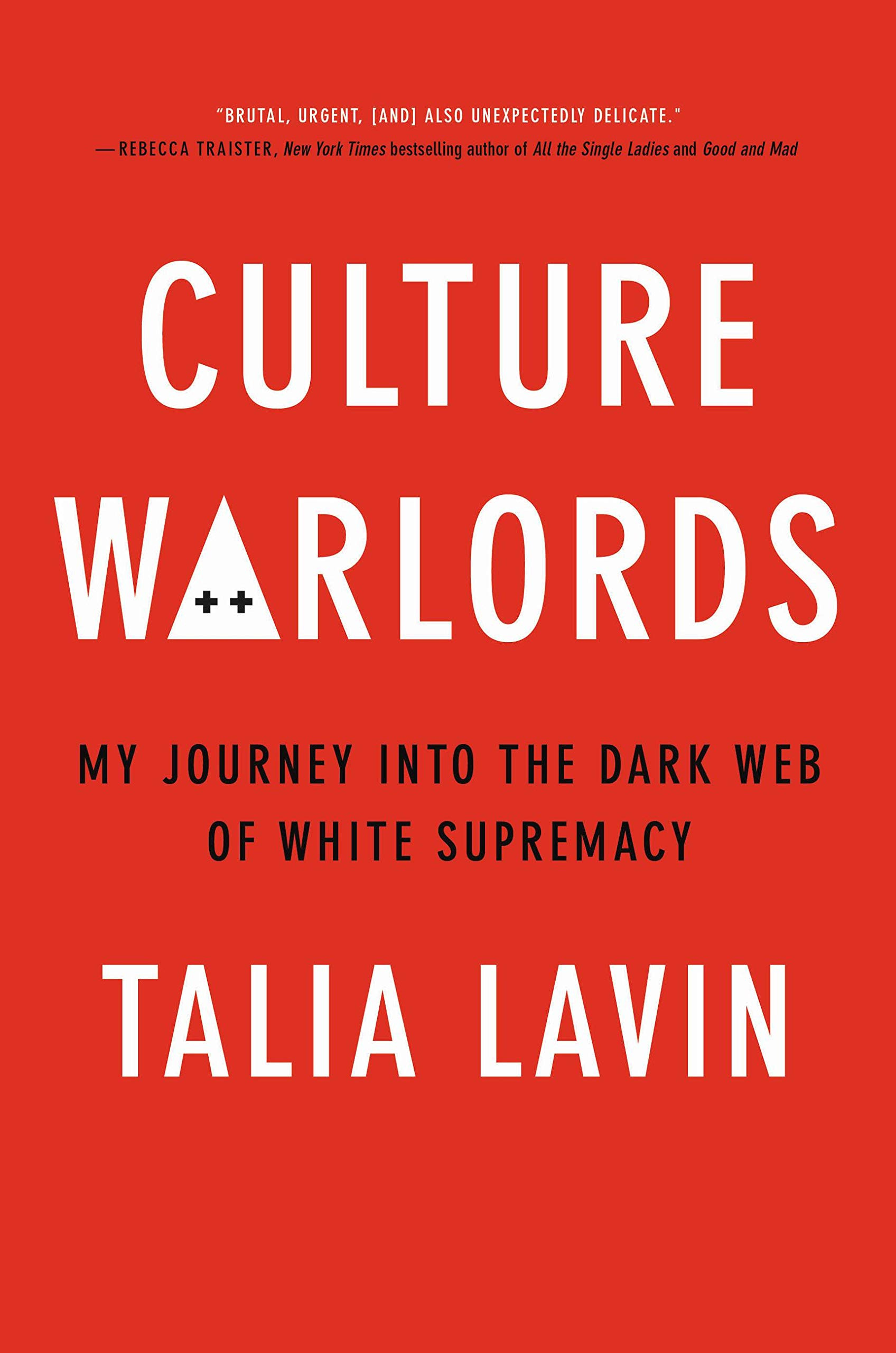
I’m reading Culture Warlords (2020) by Tal Lavin, a personal project on creating online personas to meet fascists white supremacist.
I’m listening to The Lede’s episode on queens, cities and states in the making of Africa featuring Zeinab Badawi.
I’m watching an ARTE documentary on the Malagasy AI trainers.
Chart of the week
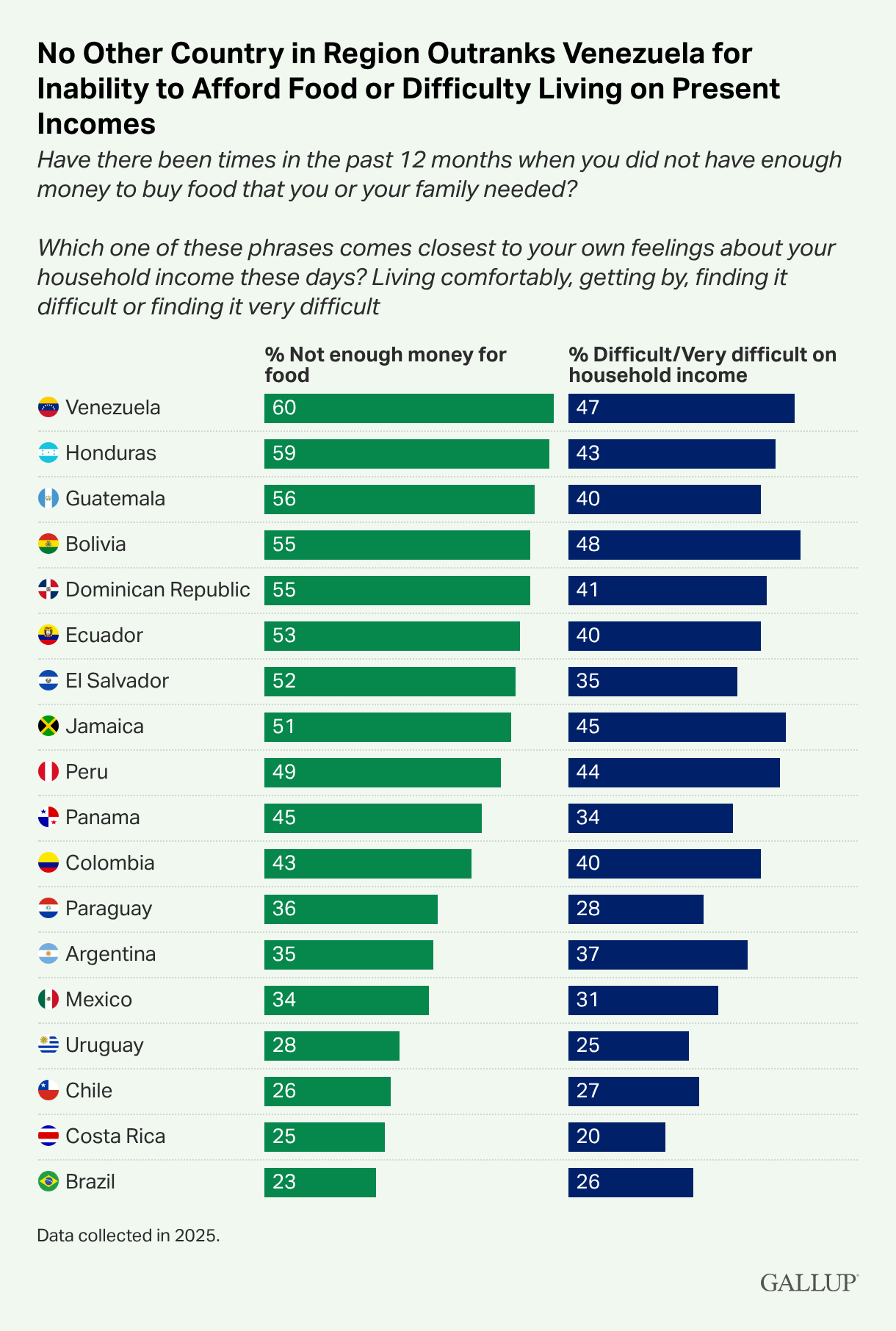
According to Gallup’s most recent survey of Venezuela in 2025, no other country in the region outranks the country for inability to afford food or difficulty living on present incomes. Benedict Viger’s writeup is here.