
The 296th Block: How would you bring the news to the front-lines?
Plus: The scammer's guide to scamming and how war affects a child's brain

This week…
Your reading time is about 5 minutes. Let’s start.
What is the most random thought you’ve had recently? On Friday, during my lunch break, I thought about how many cards, such our ID, bank card, and driver’s licence, all seem to have standardised rounded corners. Of course, I had to search what the ISO code is. You actually have to pay money to read the document, but don’t worry, Wikipedia has you covered with a summary. Anyway tl;dr: the standard rounded corners for this type of cards have a radius of 2.88-3.48 mm.
By the way, a small revamp to the format to TSB — you won’t even notice it. 😉
Your Wikipedia this week: ISO/IEC 7810 ID-1
And now, a selection of top stories on my radar, a few personal recommendations, and the chart of the week.
ICYMI: The Previous Block was about scams, fakes, and extremism.
CORRECTION NOTICE: None notified.DISINFORMATION, MEDIA & JOURNALISM

The man bringing the news to Ukraine’s front-line villages
Margaux Seigneur for Al Jazeera:
It’s a cold, foggy morning in early November, and Myroshnyk Vassyl Savych is driving north on a narrow road in eastern Ukraine towards the Russian border. He’s headed to villages where, owing to increasing exposure to Russian fire, only a fraction of residents remain. The war has cut them off from regular services. They no longer receive mail, and Russian transmitters often overpower or interfere with their Ukrainian mobile-phone signals. Before large-scale signal jamming was introduced to counter drones, Russian television and radio channels were accessible on televisions and radios in border-area communities.
In his trunk are bundles of Zorya Visnyk (The Dawn Bulletin), a local newspaper that Vassyl edits and delivers to front-line communities in Ukraine’s Kharkiv region. The newspaper doesn’t turn a profit, and distribution is dangerous, but Vassyl says it’s often the only reliable source of news that residents get all week.
Having documented the bombing of civilians in his hometown of Zolochiv, also in eastern Ukraine, when the Russian invasion began in February 2022, the editor says he feels compelled to set the record straight, village by village.
“When hospitals or homes are hit, Russian officials claim they were military targets,” he says. “Restoring the truth is our only defence.”
Loosely linked:
Pakistan sentences journalists, YouTubers and ex-military officers to life over inciting violence by Munir Ahmed for AP.
France fears ‘era of Trumpism’ as public broadcaster comes under fire from right by Angelique Chrisafis for The Guardian.
How frogs went from right-wing meme to anti-ICE protest symbol by Laura Blasey and Max Matza for BBC.
El nuevo tentáculo mediático de Vox: un canal en internet para criticar el bipartidismo desde la ultraderecha por David Romero González en elDiario.es.
Un coup d’État en plein mariage : quand la géopolitique percute l’intimité des journalistes par Hélène Brunet-Rivaillon dans La revue des médias.
DATA, AI & BIG TECH
A scammer’s guide: How cybercriminals plot to rob a target in a week
Poppy McPherson, Han Huang, and Ally J. Levine for Reuters:
A handbook found during a police raid on a compound used by a cyberfraud gang in the Philippines offers detailed instructions in Chinese for conducting scams and reveals a blueprint for grooming and deception.
“A woman’s IQ is zero when in love,” it states on its second page. “As long as the emotions are in place, the client’s money will naturally follow.”
A second handbook, seized during another law enforcement operation in the country and reviewed by Reuters, gives tips in English and Chinese about how to conduct romance scams.
Together, they provide a window into the psychological techniques criminal gangs use to beguile a victim into believing they are in a romantic relationship before duping them into fraudulent investments.
This kind of fraud is known as “pig-butchering” because the gangs say targets are led like hapless pigs to slaughter. It is among the most prevalent scams today, according to the United States’ Federal Bureau of Investigation.
Read unpaywalled version on The Straits Times here. Loosely linked:
Data is control: what we learned from a year investigating the Israeli military’s ties to big tech by Noa Yachot for The Guardian.
You’ve been targeted by government spyware. Now what? by Lorenzo Franceschi-Bicchierai for TechCrunch.
Meet the team that investigates when journalists and activists get hacked with government spyware by Lorenzo Franceschi-Bicchierai for TechCrunch.
Why should we pay these criminals?: the hidden world of ransomware negotiations by Anna Isaac for The Guardian.
Lights, camera, algorithm: Why Indian cinema is awash with AI by Viren Naidu for BBC.
AI chatbots are alarmingly biased against dialect speakers by Fintan Burke for DW.
Google AI Overviews put people at risk of harm with misleading health advice by Andrew Gregory for The Guardian.
La gran pregunta de la burbuja de la IA (y la economía global) para 2026: ¿cuándo caduca un chip? por Carlos del Castillo en elDiario.es.
De serial love à voleur en série : sur la piste d’un escroc en cavale par Laetitia Cherel dans Franceinfo.
DEMOCRACY, RIGHTS & REGULATIONS
What growing up in war does to a child’s brain - and how it really affects them years later
Fergal Keane for BBC:
The first thing was that Abdelrahman’s dad was killed. The family home was struck by an Israeli air strike. The boy’s mum, Asma al-Nashash, 29, remembers that “they brought him out in pieces”.
Then on 16 July 2024 an air strike hit the school in Nuseirat, central Gaza. Eleven-year-old Abdelrahman was seriously wounded. Doctors had to amputate his leg.
His mental state began to deteriorate. “He started pulling his hair and hitting himself hard,” Asma recalls. “He became like someone who has depression, seeing his friends playing and running around… and he’s sitting alone.”
When I meet Abdelrahman at a hospital in Jordan in May 2025, he is withdrawn and wary. Dozens of children have been evacuated to the Kingdom from Gaza for medical treatment.
“We will return to Gaza,” he tells me. “We will die there.”
Abdelrahman is one of thousands of traumatised children I’ve met in my nearly four decades of reporting on conflicts. Certain faces are embedded in my memory.
Some as though I had only met them yesterday. They reflect the depth of terror inflicted on children in our time.
Loosely linked:
Germany’s far-right AfD invited to join Munich Security Conference 2026 by Deborah Cole for The Guardian.
We’re not scared: Life in Taiwan goes on amid major Chinese war games by Jordyn Haime for Al Jazeera.
South Korea’s Lee ditches hard-line path on Kim, North Korea by Julian Ryall for DW.
Internet disruption, several arrests made as Iran protests continue by Maziar Motamedi for Al Jazeera.
Is there any legal justification for the US attack on Venezuela? by Geraldine McKelvie for The Guardian.
Has Europe’s landmark privacy law lost its bite? by Laia Charles for MIR.
China to crack down on AI firms to protect kids by Osmond Chia for BBC.
AI is intensifying South China Sea disputes in the Philippines by Nuurrianti Jalli and Angel Martinez for Fulcrum.
Es volver a la edad de Piedra: cómo el desfinanciamiento científico empieza a impactar en la vida cotidiana por León Nicanoff en elDiarioAR.
Pourquoi ni la Chine, ni les États-Unis ne domineront le monde par Guillaume Duval dans Le Grande Continent.
What I read, listen, and watch

I’m reading Theory of Water (2025) by Leanne Betasamosake Simpson. In this book, the author speaks about Indigenous connections with water. I am more of a ‘land’ Indigenous, in fact, in my home state, the colonial categorisation of the largest group of Indigenous peoples divide us into the ‘land people’ (me) and the ‘sea people.’ I don’t really resonate with bodies of water, but I respect them, of course.
I’m listening to TANGOTI on how women use less than men at work.
I’m watching ARTE’s documentary on the UN’s inability to prevent the massacre of civilians.
Chart of the week
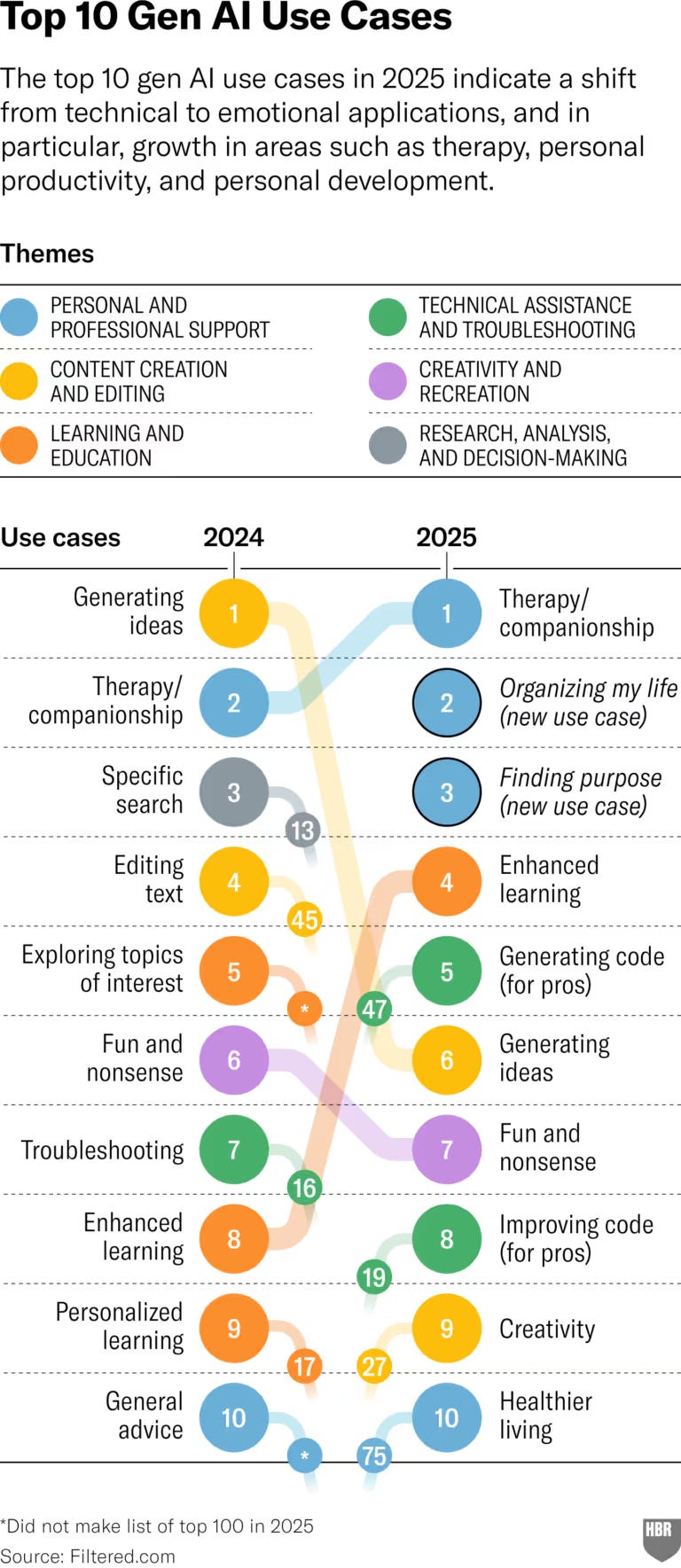
Editors at the Harvard Business Review shared a few charts that to summarise 2025, including this one on how people are really using generative AI in 2025. Other charts include how ‘workslop’ makes colleagues think differently of each other, and something about ‘vibecession’.