
The 295th Block: Verify the rivals
Scams, fakes, and extremism

This week…
Your reading time is about 5 minutes. Let’s start.
This week, I read two fiction novels — Jane Pek’s The Verifiers (2022) and its sequel The Rivals (2024). I don’t remember how these books went into my to-read pile on my libary app, but I’m glad I managed to read them back-to-back. They offer a refreshing take on the implications of AI in dating apps, digging into digital twins, personal data, and surveillance technology.
At first, I was a little thrown off by how often the main character referenced fictional detectives from classic literature (and in-universe fictional heroes) while working at an online dating detective agency. It felt a bit too meta, and at times it seemed like the author was over-explaining spy-thriller tropes through these references. I assumed that might explain why the book’s rating was lower than I expected when I checked midway through the first novel. (Ratings don’t usually bother me, I was just curious whether others felt the same.)
It turns out most of the lower ratings were people complaining that the techy parts were too technical. Those were my favourite parts, actually: Pek did her research well, and presented plausible scenarios in each of cases her characters worked on. By the end, the detective homages didn’t bother me at all — they’re exactly that: homage. There’s a whole lot more to say about the main character being Asian, gay, and living in the West… but, alas, this is not a book review blog. :)
If you’re in the mood for a fictional take on online privacy, surveillance tech, AI, and big data, rather than the non-fiction I usually recommend, this series (there is going to be a third book, right?) is worth your time.
Your Wikipedia this week: ELIZA effect
Also, have you seen this?
And now, a selection of top stories on my radar, a few personal recommendations, and the chart of the week.
ICYMI: The Previous Block was about language, the right, and the media. FWIW:
How far right is infiltrating everyday culture by Ashifa Kassam for The Guardian.
CORRECTION NOTICE: None notified. CYBERSECURITY
The LinkedIn job scam is global. The hook is local
Damilare Dosunmu for Rest of World:
LinkedIn job scams have become a borderless epidemic, preying on the hopes of desperate job seekers and costing victims across the globe anywhere from a few hundred dollars to $25,000.
While the Microsoft-owned professional networking platform connects millions of users to opportunities, it also serves as a shared hunting ground for fraudsters. From Nairobi and Lagos to Mumbai and Mexico City, a review of the fraudulent schemes reveals a crucial layer often missed: Scammers are masterfully tailoring their tactics to specific cultural expectations, industry trends, and economic pressures.
In India, tech jobs are used as bait because the industry employs millions of people and offers high-paying roles. In Kenya, the recruitment industry is largely unorganized, so scamsters leverage fake personal referrals. In Mexico, bad actors capitalize on the informal nature of the job economy by advertising fake formal roles that carry a promise of security. In Nigeria, scamsters often manage to get LinkedIn users to share their login credentials with the lure of paid work, preying on their desperation amid an especially acute unemployment crisis.
In its transparency report for July–December 2024, LinkedIn said it had identified and removed 80.6 million fake accounts at the time of registration, up from 70.1 million in the prior six months. In the U.S., job scam texts were the second most common type of hoax reported in 2024, after fake package deliveries, according to data from the Federal Trade Commission.
Loosely linked:
They answered an ad for surrogates, and found themselves in a nightmare by Sarah Topol for NYT via Pulitzer Center.
‘All brakes are off’: Russia’s attempt to rein in illicit market for leaked data backfires by Pjotr Sauer for The Guardian.
New Somalia e-visa security flaw puts personal data of thousands at risk by Yarno Ritzen for Al Jazeera.
AI
Extremists are using AI voice cloning to supercharge propaganda
Ben Makuch for The Guardian:
While the artificial intelligence boom is upending sections of the music industry, voice generating bots are also becoming a boon to another unlikely corner of the internet: extremist movements that are using them to recreate the voices and speeches of major figures in their milieu, and experts say it is helping them grow.
“The adoption of AI-enabled translation by terrorists and extremists marks a significant evolution in digital propaganda strategies,” said Lucas Webber, a senior threat intelligence analyst at Tech Against Terrorism and a research fellow at the Soufan Center. Webber specializes in monitoring the online tools of terrorist groups and extremists around the world.
“Earlier methods relied on human translators or rudimentary machine translation, often limited by language fidelity and stylistic nuance,” he said. “Now, with the rise of advanced generative AI tools, these groups are able to produce seamless, contextually accurate translations that preserve tone, emotion, and ideological intensity across multiple languages.”
On the neo-Nazi far-right, adoption of AI-voice cloning software has already become particularly prolific, with several English-language versions of Adolf Hitler’s speeches garnering tens of millions of streams across X, Instagram, TikTok, and other apps.
Loosely linked:
Deepfakes leveled up in 2025 – here’s what’s coming next by Siwei Lyu (University at Buffalo) for The Conversation.
How ChatGPT could change the face of advertising, without you even knowing about it by Nessa Keddo (King’s College London) for The Conversation.
More than 20% of videos shown to new YouTube users are ‘AI slop’, study finds by Aisha Down for The Guardian.
China issues draft rules to regulate AI with human-like interaction by Liangping Gao and Ryan Woo for Reuters.
Other curious links, including en español et français

LONG READ | Myanmar youth in exile slam military-run ‘sham’ election by Ali MC for Al Jazeera.
PHOTO ESSAY | Tibetans depart Nepal, a former safe haven transformed under Chinese pressure by Manish Swarup, David Goldman, and Aniruddha Ghosal for AP.
IA: ¿y si el negocio les sale mal? por Esteban Magnani en Anfibia.
El ‘fallido’ sistema de revistas científicas: la mayoría de los estudios más citados salen en publicaciones ‘menores’ por Daniel Sánchez Caballero en elDiario.es.
Hablantes, cultura y poder: cómo medir la importancia de una lengua por Rafael del Moral en El Confidencial.
Nicolas Sarkozy, Jordan Bardella, Philippe de Villiers... Pourquoi les livres des personnalités politiques de droite et d’extrême droite se vendent aussi bien par Laure Cometti et Thibaud Le Meneec dans Franceinfo.
Les utilisateurs « sont fatigués » : la bouillie générée par IA est-elle sur le point de tuer son premier réseau social ? par Amine Baba Aissa dans Numerama.
« Dynamiter l’omerta » : lorsque les journalistes enquêtent sur leur propre famille par Léa Le Denmat dans La revue des médias.
What I read, listen, and watch

I’m reading The Verifiers (2022) and The Rivals (2024) by Jane Pek.
I’m listening to Code Switch on keeping culture and tradition alive at the mahjong table with Nicole Wong and the Mahjong Project.
I’m watching a Bloomberg investigation on the “laptop farm” case involving a North Korean remote worker scheme.
Chart of the week
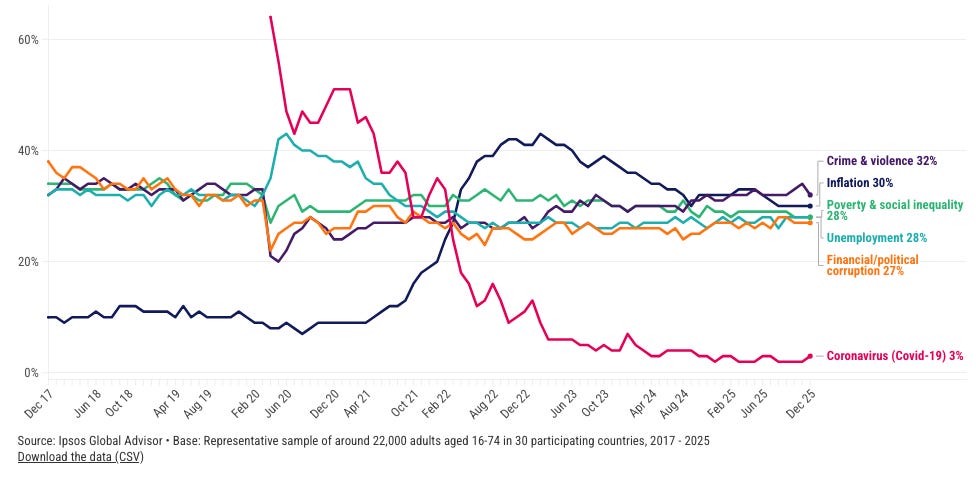
According to this month’s Ipsos survey on what worries the world, crime and violence ranked at the top (32 per cent) followed by inflation (30 per cent) and poverty and social inequality (28 per cent). Unemployment (28 per cent) and corruption (27 per cent) round up the top five topics found most worrying across 30 countries (n ≈ 22,000).