
The 294th Block: Mind your language
And the radicals

This week…
Your reading time is about 5 minutes. Let’s start.
Since its inception, The Starting Block has not taken a week off. Wild. I internally debated if I should, but, I like to keep a streak running, like my Duolingo streak (2,137 days, by the time you read this) and my Reddit streak (we don’t have to talk about it).
Your Wikipedia this week: Extremely online
And now, a selection of top stories on my radar, a few personal recommendations, and the chart of the week.
ICYMI: The Previous Block was about social and traditional media. FWIW:
The global battle to age-gate the internet by Lydia Morrish for Coda.
Ce n’est pas aux jeunes qu’il faut interdire les réseaux sociaux par Laurent François dans En Vivance.
CORRECTION NOTICE: None notified. WORD
Mark Carney criticised for using British spellings in Canadian documents
Leyland Cecco for The Guardian:
Mark Carney says that amid a fundamental shift to the nature of globalisation, his government will catalyse the growth in both the public and private sector.
But Canadian linguists say that’s a problem.
Language experts have called out the Canadian prime minister’s growing “utilisation” of British spellings in key documents – including the recent federal budget and a press release issued following a meeting with Donald Trump.
Carney, who served as the governor of the bank of England for seven years, appears to have run afoul of Canadian linguistic norms, returning to his home country with a penchant for using ‘s’ instead of ‘z’ – a hallmark of British spellings.
In an open letter chastising the prime minister, six linguists have asked his office, the Canadian government and parliament to stick to Canadian English spelling, “which is the spelling they consistently used from the 1970s to 2025”.
They warned that if governments start to use other systems for spelling, “this could lead to confusion about which spelling is Canadian”.
Canadian English is a source of immense pride for the nation’s pedants. But the country’s distinct and somewhat arbitrary spelling reflects the legacy of how Canada was colonized.
At the time of sharing, the word ‘colonized’ [sic] was spelled with a ‘z’ in this article published in a British publication. Loosely linked:
Why not just anyone can use the Toronto accent for internet clout by Amelia Eqbal for CBC News.
French-language content law could affect Quebecers’ access to Spotify, Netflix: industry groups by Joe Lofaro for CTV News.
The trouble with idioms: How they can leave even fluent English speakers behind by Frank Boers (Western University) for The Conversation.
Slop, vibe coding and glazing: AI dominates 2025’s words of the year by Gail Flanagan (University of Limerick) for The Conversation.
RIGHT
Make Korea great again: The right-wing group wooing disenchanted youth
Jake Kwon for BBC:
The line for a selfie with South Korea’s disgraced former President Yoon Suk Yeol stretched around Seoul’s iconic Gwanghwamun gate.
Except Yoon wasn’t there; it was just a picture of him.
The real Yoon is in prison facing insurrection charges. But that didn’t matter to the thousands of excited young men and women who had joined the rally organised by right-wing youth group Freedom University.
Spearheaded by 24-year-old student Park Joon-young, Freedom University opposes what it sees as a status quo of corrupt, left-wing South Korean governments promising much but delivering little, especially for the nation’s youth.
And in Yoon, they have found an unlikely hero.
On the night of 3 December last year, Yoon, whose party had lost its majority in parliament, launched a desperate bid to reverse his fortunes by declaring martial law.
He ordered troops into the parliament and the national election commission, claiming, without offering any evidence, that the country was under threat from North Korean sympathisers and Chinese spies who were conspiring to steal elections.
Yoon’s move was defeated within hours, as furious South Koreans rallied. Thousands of citizens blocked the soldiers, and lawmakers made it inside the National Assembly - some even scaling the walls - to vote down the order.
Yoon was impeached soon after and is now on trial, facing the possibility of life in prison. The saga was considered his political death. But to some, it has also made him a martyr.
Loosely linked:
Young, far-right and radical? Meet the AfD’s future leaders by Matthew Moore for DW.
Ultra-conservative José Antonio Kast elected Chile’s next president by Tiago Rogero for The Guardian.
‘The Nazis were right’: What the leaders of Canada’s biggest ‘nationalist’ group really want by Christina Paas-Lang, Jordan Pearson, and Ivan Angelovski for CBC News.
MEDIA
China’s invisible journalists
Bing Xiao for Lingua Sinica:
As a Chinese news assistant, W has never received a byline for any news report, even though he has been involved in the genesis of nearly every story, and even though — like all fixers — he is involved in every stage of the process, from contacting interview subjects to translating, from applying for interview permits to introducing foreign reporters to Chinese local contexts and social customs, to handling emergencies. The work of W and other news assistants is critical to on-the-ground reporting by foreign correspondents in China.
Zeng Qingxiang (曾慶香), a professor at the School of Journalism at Communication University of China, once pointed out in an article called “News Fixer: The ‘Invisibles’ of International Reporting” that “industry generally considers news fixers to be intermediaries between professional journalists and interviewees.” Fixers, Zeng writes, handle such tasks as renting vehicles, booking hotels, locating interview subjects, conducting interviews, translation and communication, and ensuring the safety of correspondents in dangerous environments. But the professor also notes that “there exists a degree of tension in the relationship between fixers and journalists: beyond the employment relationship, fixers and journalists also learn from each other and compete for byline credit.”
Loosely linked:
Hong Kong billionaire Jimmy Lai tested China’s limits. It cost him his freedom by Grace Tsoi for BBC.
When it matters most, student journalists are showing up by Pacinthe Matter for The Walrus.
Other curious links, including en español et français
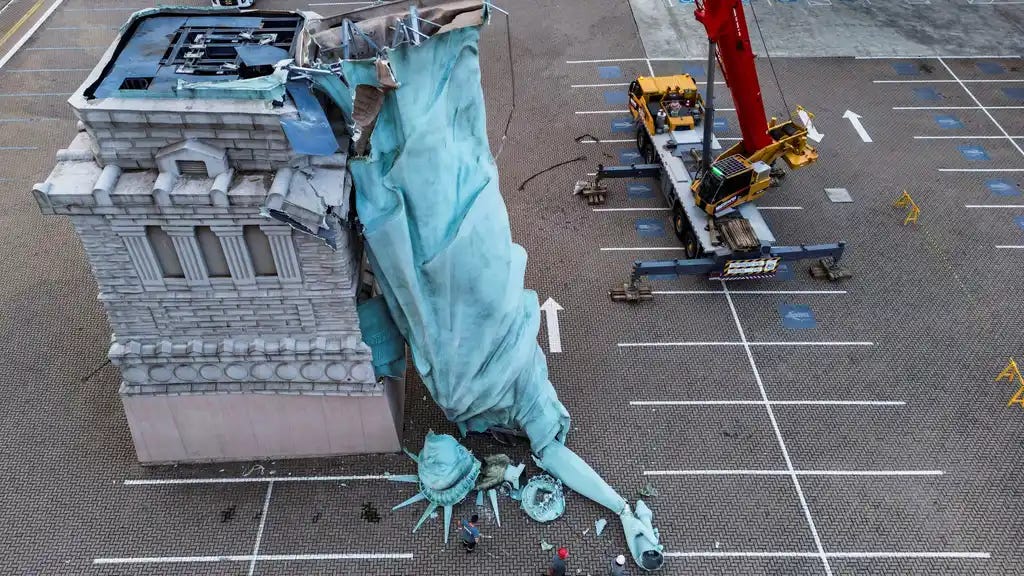
LONG READ | Big bets and broken unicorns: Tiger Global’s rise and reckoning by Issie Lapowsky, illustration by Nicolas Ortega for Rest of World.
INFOGRAPHIC | We mapped the world’s hottest data centers by Hazel Gandhi and Rina Chandran for Rest of World.
PHOTO ESSAY | Invisible infrared surveillance technology and those caught in its digital cage by David Goldman, Ng Han Guan, Felipe Dana, and Dake Kang for AP.
Los tecno-oligarcas colonizan Washington por Enzo Girardi en Anfibia.
La deuda pendiente de España con las hijas e hijos de inmigrantes por José Sánchez Sánchez en CTXT.
Un retrato de hombres adictos a la pornografía en México por Jair Ortega de la Sancha en Gatopardo.
Un quart des Français visitent les sites d’infos générées par IA recommandés par Google par Jean-Marc Manach dans Next.
Lenteur, débrouille et résistance : voici l’Internet des sans-Internet par Nastasia Hadjadji dans Usbek & Rica.
Le sentiment contre l’immigration connaît un certain essor au Canada par David Baxter dans La Presse.
What I read, listen, and watch
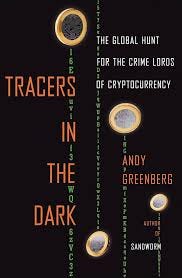
I’m reading Tracers in the Dark (2022) by Andy Greenberg. A few months ago at a get-together, a friend who works in… an adjacent field recommended the book to me. When I went to add it to my to-read pile, I realised it has been there for MONTHS. I finally got around to it, and it’s insightful, but it’s horrifying towards to the end. If you are not in a good headspace, don’t read it.
I’m listening to On The Media about how 2025 is the year Big Tech embraced fakeness.
I’m watching FT’s report on the globalisation of scamming syndicates and the proliferation of crime-as-a-service tools.
Chart of the week
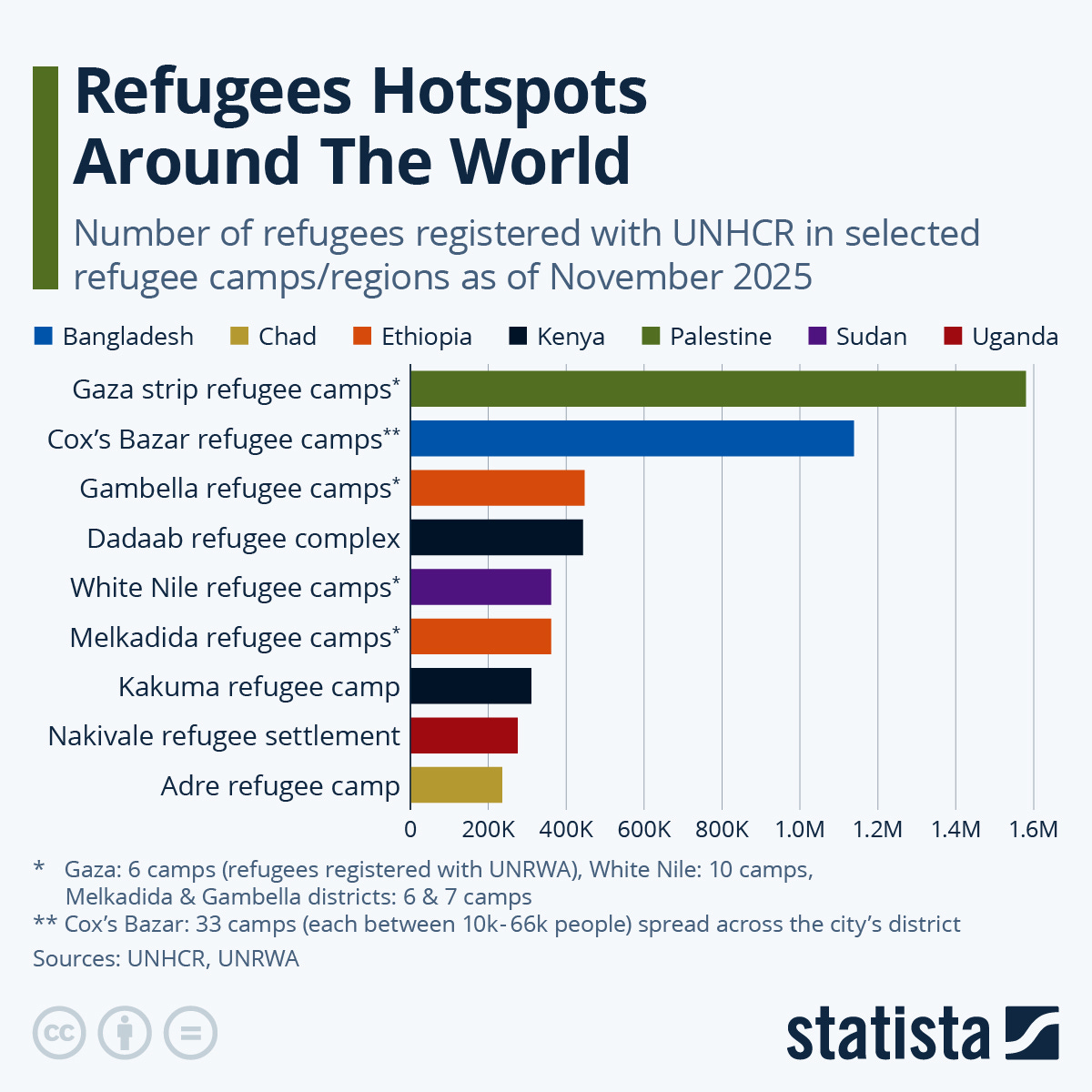
Statista’s Tristan Gaudiaut summarised the largest refugees hotspots according to UN agencies as of November 2025. International Migrants Day was commemorated on December 18.