
The 336th Block: Media down, AI up

This week…
Your reading time is about 5 minutes. Let’s start.

It’s International Day of the World’s Indigenous Peoples on August 9. Here’s what’s working for environment solutions in their communities, according to Indigenous leaders, as reported by Latoya Abulu for Mongabay.
Your Wikipedia this week:
And now, a selection of top stories on my radar, a few personal recommendations, and the chart of the week.
ICYMI: The Previous Block was about secret and spies. FWIW:
Chinese spies are recruiting Canadians on LinkedIn by Sushant Singh for The Walrus.
CORRECTION NOTICE: None notified.DISINFORMATION, MEDIA & JOURNALISM
‘I terminated this channel’: Inside the fake copyright racket silencing news outlets
OCCRP:
Independent media often face off against autocratic governments in countries like Georgia. But last week, OCCRP member center Monitori was forced to contact a tech giant to fend off a censorship attempt: YouTube.
When Monitori’s YouTube channel suddenly disappeared, the outlet received an emailed explanation. It had been taken down due to claims of copyright infringement against three videos.
One video featured a collection of luxury Hermès handbags belonging to the wife of a politician. Another video focused on sanctioned judges, while the third detailed cigarette excise tax changes that benefited a government-linked businessman.
Claiming copyright infringement is an increasingly common tactic to silence journalists and civil society, according to Alberto Fittarelli, a senior researcher specializing in disinformation at Toronto-based Citizen Lab. It’s especially hard to fight since the burden of proof is on the victims to challenge accusations of copyright infringement.
“The abuse of copyright infringement reporting channels is particularly effective,” said Fittarelli. “Because it is virtually invisible to the platforms’ (unaffected) users, unlike for example bots’ comments or posts, it remains incredibly underestimated.”
In notification emails sent to Monitori, YouTube stated that the complaints originated from three accounts, including one named Ripu Singh. He had claimed the Monitori “videos copied and reused my thumbnail design and images without permission.”
YouTube’s notification listed an email address for the complainant, so a reporter sent a message posing as a potential client wanting to take down videos posted by a media outlet.
The reporter received a response almost immediately: “So you want to terminate a channel, can you drop the link to that, so we tell you the price?”
Loosely linked:
Pakistani authorities ban international media from reporting in most of country by Shah Meer Baloch for The Guardian.
China’s multi-layered propaganda machine targets Czechia by Aleksandra Bielakowska for RSF.
Rights groups say Israeli attack that killed Lebanese journalist an apparent war crime by Samantha Granville for BBC.
Luisa María Alcalde y las audiencias, un lío evitable por Jorge Zepeda Patterson en El País.
Le bâillonnement de l’opinion au Mali par Frédéric Couteau dans RFI.
AI
Growth without work: The human cost of the AI revolution
Jibu Elias for Rest of World:
At the turn of the millennium, India became the global hub for medical transcription. With fiber optic cables laid in the 1990s, American hospitals found it cheap and efficient to beam voice files across the ocean. Indian workers, fluent in English and medical terminology, turned dictations into polished reports overnight. The time-zone gap became an advantage: a surgeon in Boston could dictate before bed, and wake up to flawless notes typed in Bengaluru.
By the early 2000s, the industry seemed secure. Companies built training academies, invested in IT systems and promised young recruits that this was a career with a future.
But when I met Aakash (name changed) in June 2024, that promise had already unravelled. At 25, he was clinging to a short-term contract in a Bengaluru firm. He had joined a year earlier, after months of training. During recruitment, he asked the CEO whether AI posed a threat. ‘At least five years away,’ came the reassurance.
Yet, by March 2024, as the financial year closed, American clients began to vanish. Contracts were cancelled or shifted to automated platforms. Hundreds of jobs disappeared almost overnight. The cafeteria that once buzzed at 3 a.m. emptied out. Hiring froze; the recruitment team itself was laid off. New employees were brought in under “conditional retention training,” only to be dismissed weeks later (an accounting trick to show inflated headcounts to prospective clients) and workers lived in limbo. Economists have a phrase for jobs like Aakash’s: high exposure, low complementarity. Which means that these are roles where machines can easily take over, rather than raising the human’s capacity to work.
Loosely linked:
The global grassroots gatherings trying to humanize the AI boom by Rina Chandran for Rest of World.
The future of knowledge workers in an AI-driven world by Aaron Horwath for Noema.
How an OpenAI influencer trip backfired by Mia Sato for The Verge.
Cómo resistir al futuro sintético por Francesca Cantore en Revista Anfibia.
Aux Philippines, une armée d’infirmiers surveille des patients d’hôpitaux américains à distance par Mathilde Simon dans Usbek & Rica.
What I read, listen, and watch

I’m reading Manipulating the Message (2023) by Cecil Rosner.
I’m watching DW’s documentary on how how apps on our phones collect data.
I’m listening to Media Storm on fighting news fatigue.
Chart of the week
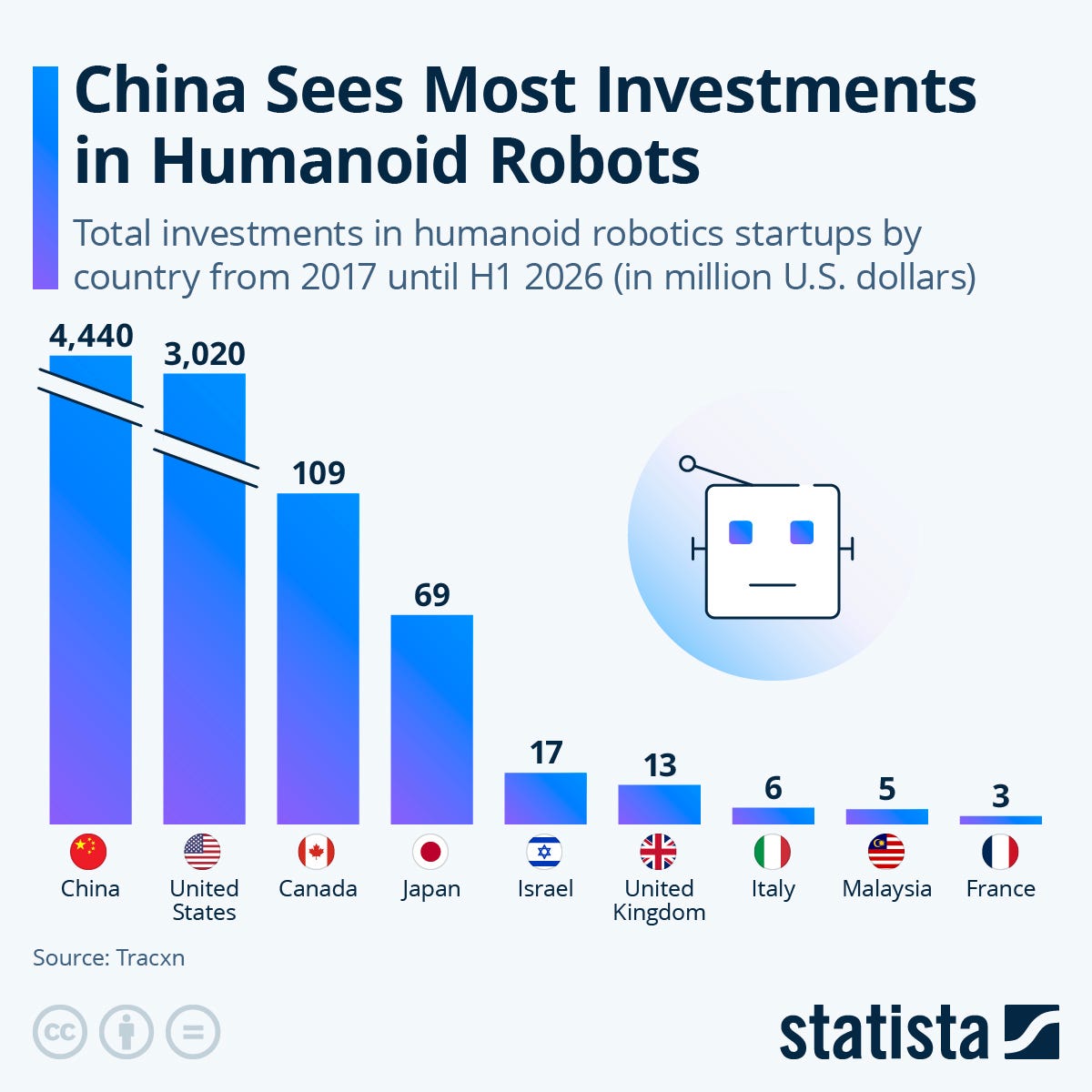
China sees most investments in humanoid robots, reports Katharina Buchholz for Statista, with data published by Tracxn.