
The 319th Block: Extreme and influenced

This week…
Your reading time is about 5 minutes. Let’s start.
I am in the thick of my end-of-module law assignment, which is due in early July. I have not a lot of time for the news, sadly. But on the flip side, having less contact time with the news is helping quite a bit with my mental health. To be honest, I have spent almost every day on the desk bike I wrote about last week. And while I could work, analyse the news, or draft my assignment while riding the bike, I have mainly been doing leisurely stuff like watching anime (currently watching: Hunter x Hunter and Demon Slayer) or sports (this summer, I’m following the T20 Women’s World Cup and WNBA) instead. Work-life balance or whatever they call it.
Also - is it just me or are escape room-type of activities are getting more popular? Not complaining! I love-hate it. 😂 Ah, wait, is this why the Metaverse…
Your Wikipedia this week: Bread and circuses
And now, a selection of top stories on my radar, a few personal recommendations, and the chart of the week.
ICYMI: The Previous Block was not anti-China propaganda.
CORRECTION NOTICE: None notified.EXTREMISM & THE ONLINE NETWORK
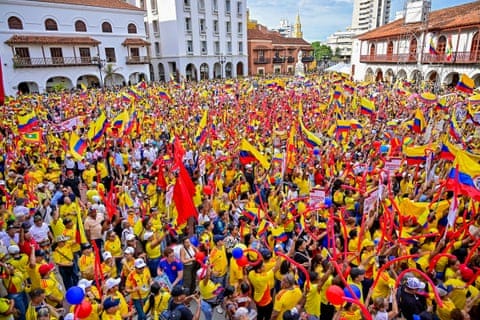
Ghost of far-right paramilitaries hovers over Colombia’s presidential runoff vote
Tiago Rogero for The Guardian:
Whoever wins Sunday’s presidential runoff vote in Colombia, the country’s next leader will have a personal history intertwined with one of the criminal forces at the heart of a decades-long armed conflict that claimed nearly half a million lives.
The lives of Iván Cepeda and Abelardo de la Espriella have, in very different ways, been shaped by their relationship with Colombia’s paramilitaries – private armies originally established by rightwing landowners, drug traffickers, businessmen, mining magnates and politicians to fight leftwing guerrilla groups.
De la Espriella, 47, a far-right admirer of Donald Trump and self-styled outsider, launched his legal career defending paramilitary leaders.
Cepeda’s father was assassinated by army officers linked to a paramilitary group, and the 63-year-old leftwing senator forged his public career as a human rights activist exposing those groups’ crimes.
The winner will take office on 7 August and inherit the country’s worst violence since the landmark 2016 peace agreement between the government and most of the Revolutionary Armed Forces of Colombia.
The two candidates advocate opposing strategies for dealing with the surge in crime.
Loosely linked:
How Sweden’s far right went from political pariah to powerbroker by Nils Adler for Al Jazeera.
As Brazilian media embrace prediction markets, experts warn of election distortion by Leonardo Coelho for LJR.
The malignant rise of OnlyFans managers: ‘It’s exploiting. It’s grooming. It’s predatory’ by Amelia Gentleman for The Guardian.
Brands using AI-generated influencers to promote products on social media by Sarah Marsh for The Guardian.
La enciclica, Peter Thiel y una gigantomaquia cosplay: La gran batalla de nuestro tiempo por Flavia Costa en Revista Anfibia.
Comment le milliardaire d’extrême droite Pierre-Edouard Stérin s’est lancé dans le cinéma en toute discrétion par Elodie Guéguen et Elsa Sabado dans France Info.
Autour du Quai d’Orsay, une galaxie d’influenceurs pour combattre les attaques contre la France sur les réseaux sociaux par Tom Hollmann dans France Info.
What I read, listen, and watch

I’m reading To Place a Rabbit (2025) by Madhur Anand. The title is the literal translation of poser un lapin (to stand someone up). A scientist met an author promoting a novella that was originally written in English but only published in French. A scientist offered to translate the book back to its original language. I love reading about language and translation, and I was immediately intrigued by this premise. The process led her to reminisce about her French ex-lover, wanting to adapt their love story into a novel. Madhur Anand’s style of writing is a cerebral. Alex Trnka in a review calls it “abundant with metanarratives and structural loops,” where “key stories and details double, perspectives merge [and split] ... and the absence of names creates an illusion of multiple overlapping worlds. If you are the kind of revel in textual “complexity and confusion,” you will enjoy the writing style.
I’m watching ARTE’s documentary on the anti-Nazi youth movement. Sometimes you just need to watch something like this for a little hope. 🤷🏽♀️
I’m listening to Click Here exploring what if the most interesting thing about China’s internet isn’t what it keeps out... but what grew within it?
Chart of the week
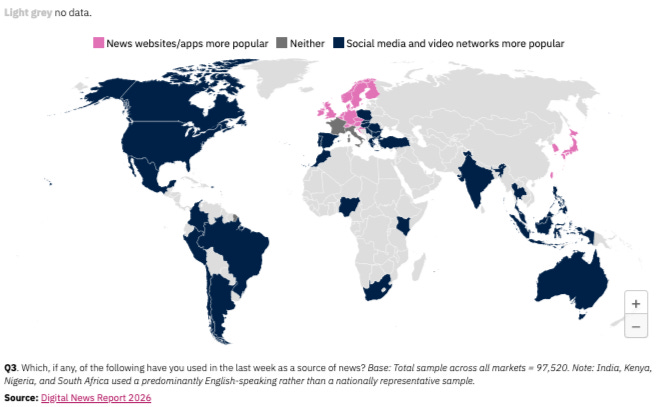
Reuters Institute released their annual Digital News Report. Haven’t had the time to read through it properly, but here’s the relative popularity of social media and video network versus news websites and apps according to the report.