
The 313th Block: Death by disease or disinformation
The Internet is ungovernable

This week…
Your reading time is about 5 minutes. Let’s start.
I consume the news throughout the week and bookmark the links in my browser’s neatly categorised folders… except this week I was trying to find a tumblr post I bookmarked earlier in the week when I first heard about the pistachio conspiracy on TikTok, and couldn’t find it. It was later found in my law studies folder. 🙄 I’m eyeballs deep in assessing whether criminal law should require corroboration in eyewitness identification and hearsay. I always enjoy the human rights aspect of my law studies (in this case, the right to fair trial intersects with corroboration through the need for safeguards against wrongful conviction) but I don’t think I’m cut for courtroom lawyering or whatever. Anyway! Short edition this week!
Conspiracy theory watch-list: The pistachio thing
Your Wikipedia this week: The discussion page for the request to change the Orthohantavirus article title to Hantavirus. In particular, this opposing view.
And now, a selection of top stories on my radar, a few personal recommendations, and the chart of the week.
ICYMI: The Previous Block was about Hungary, refugees, and dictatorial influencers.
CORRECTION NOTICE: None notified.MEDIA, SOCIAL MEDIA, AND MISINFORMATION
Fake rumours, real killings: Inside Congo’s deadly health misinformation crisis
Jessica Donati, Fiston Mahamba and Rachael Kennedy for Reuters:
In Tshopo, a northeastern Congolese province blanketed in rainforest, rumours rippled through villages late last year claiming a mysterious illness had caused men’s genitals to atrophy.
Within days, testimonials proliferated on social media that amplified the imaginary threat, triggering a real-life panic that turned deadly before the government could react.
Angry mobs attacked and killed four health workers conducting vaccination research in an episode that took place in October, four officials and a survivor told Reuters - a deadly example of the rising danger posed by online health misinformation in Africa.
The violence has since spread to other parts of the Democratic Republic of Congo. In all, at least 17 killings related to the atrophy rumour have been reported, including the health workers, according to the WHO-led Africa Infodemic Response Alliance, which monitors fake health information. Reuters could not independently verify the other deaths.
In Congo, misinformation “really led to death and murder,” said the Nairobi-based alliance’s director Elodie Ho. “It started in communities. It spread into social media and local media. It was amplified by those actors.”
Loosely linked:
Hantavirus brings back old conspiracy theories by Jessica Mouzo for El País.
Facebook is a hub for illegal wildlife trade, and that’s by design, report says by Spoorthy Raman for Mongabay.
Brazil’s Ctrl+Z aims to use journalism to pressure Big Tech by Leonardo Coelho for LJR.
‘Factory of lies’: what will Péter Magyar do about Hungary’s state media? by Ashifa Kassam and Flora Garamvolgyi for The Guardian.
The Epstein Files: the AI podcast that sounds like journalism but isn’t by Kathryn McDonald (Bournemouth University) for The Conversation.
How to survive the information crisis: ‘We once talked about fake news – now reality itself feels fake’ by Katharine Viner for The Guardian.
A bet is not a poll by C.J. Robinson for CJR.
Ataques al uribismo y conspiraciones: los activistas digitales de De la Espriella promueven su estrategia más radical por Diego Stacey en El País.
El Gobierno de Bukele escala el acoso a El Faro con la congelación de bienes a sus socios por Bryan Avelar en El País.
La IA podrá ver todos los mensajes privados de Instagram a partir de hoy: “Imagina que el cartero leyera tus cartas” por Carlos del Castillo en elDiario.es.
Pluralisme politique à la télévision et à la radio : comment font nos voisins ? par Xavier Eutrope en La revue des médias.
“Seul l’art peut remplir ce trou dans le réel” : comment Xavier Dupont de Ligonnès est devenu un personnage de fiction récurrent par Pierre Godon dans Franceinfo.
“Les masques, les blouses... C’est un film de science-fiction” : aux Canaries, le retour sous haute surveillance des passagers du “MV Hondius” par Raphaël Godet dans Franceinfo.
What I read, listen, and watch
I’m reading Lurking: How a Person Became a User (2020) by Joanne McNeil. It’s quite a throw-back to the olden days, even pre-Friendster and MySpace, pre-ICQ and LiveJournal, even. I wonder how my neopets are doing! I felt nostalgic about Internet forums… I used to mod several of them with an iron fist, but no where quite like these modern day mods on Reddit on a power trip.
I’m listening to Click Here’s podcast titled “It didn’t look like propaganda” about Pavel “Pasha” Talankin award-winning, ethically ambiguous film on the Russian invasion of Ukraine.
I’m watching Bloomberg’s how to spot a Russian deepfake. Preferrably I’d like to be able to spot all deepfakes, not just Russian. But it’s a start.
Chart of the week
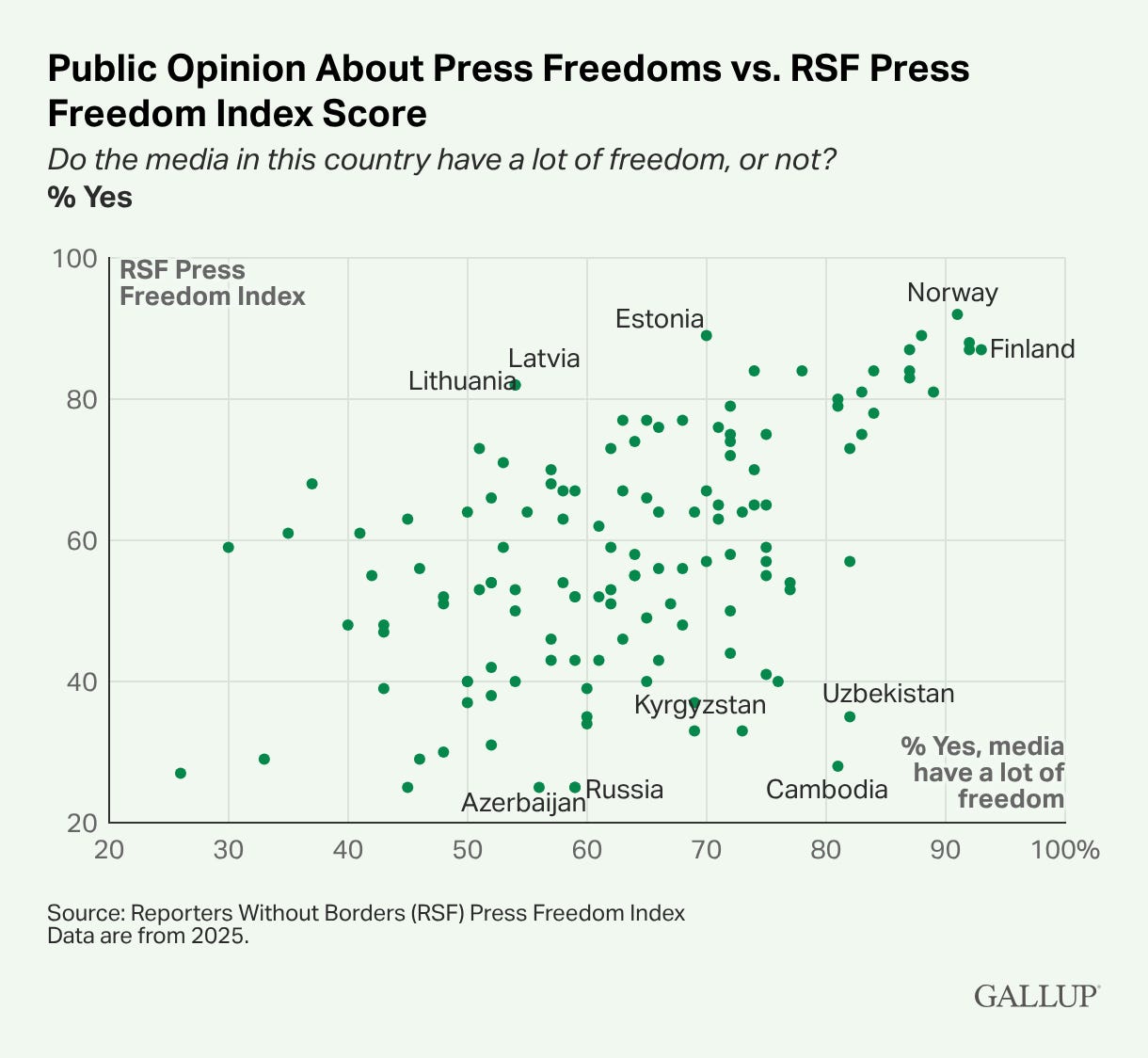
For a little bit more context to the Reporters Without Borders’ World Press Freedom Index, Gallup showed links between perception of press freedom and external evaluation vary between countries. Or, some countries are quite delusional. Benedict Vigers has more.