
The 309th Block: All librarians are shy!
All AI is bad!

This week…
Your reading time is about 5 minutes. Let’s start.
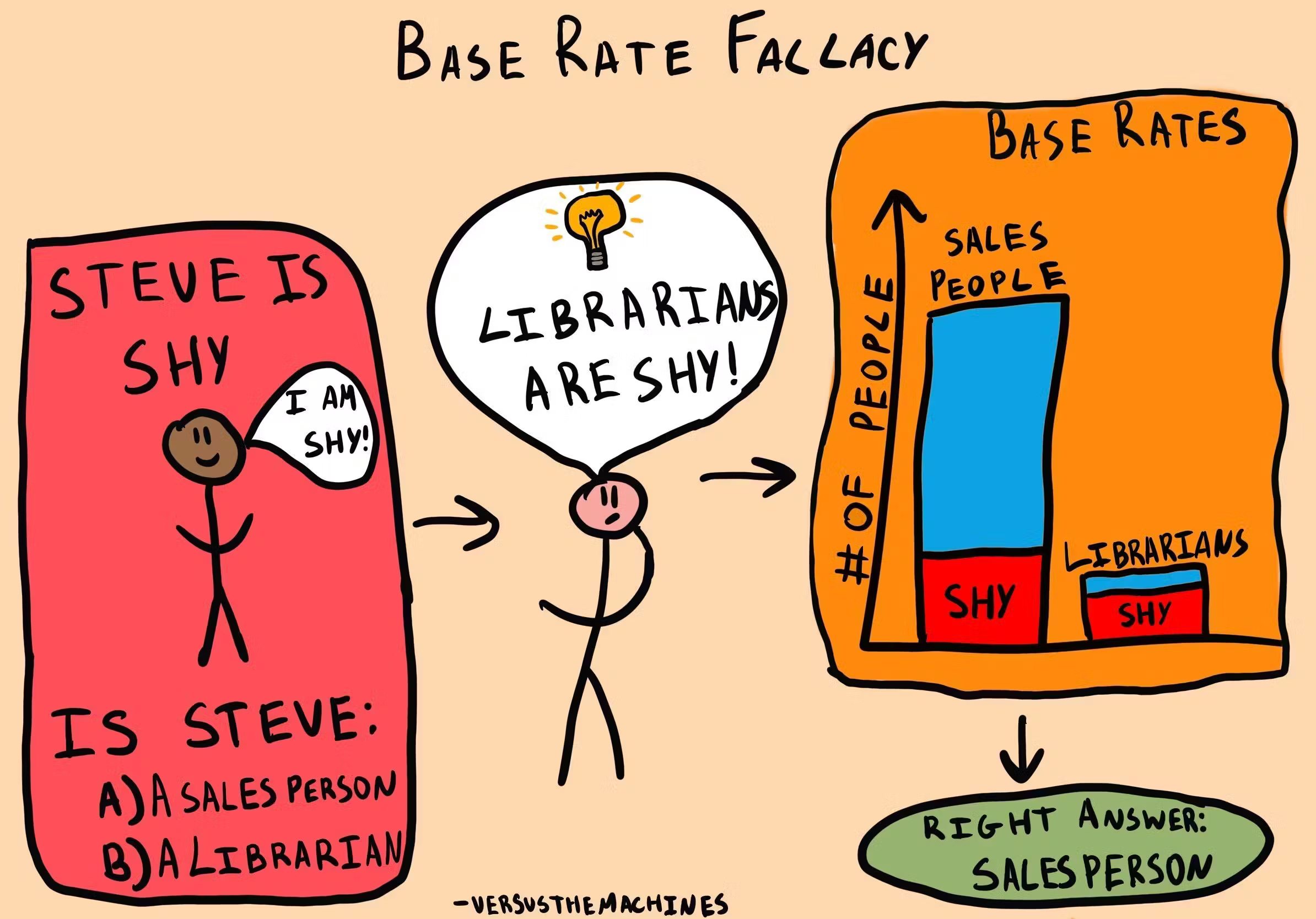
I was supposed to write an long piece this week, so I had shortened the succeeding sections so that it doesn’t get too lengthy. However, I got caught up on trying to get ahead in my studies (witness evidence) and only started working on my draft this morning. 💀
I am sure I can finish the draft today, but I am not sure we want toread a rough draft without any attempts at editing at all. So I am pushing it to next week. But that means that this week’s edition is a lot shorter than usual. Maybe we can play a little game. I can share the list of preliminary references that I have collected for this piece, and you can guess what it’s about. I won’t tell you the topic, or the thesis statement, but the reference list could give you a clue. (Please don’t put this into a generative AI tool to produce an essay.)
Dietrich, R. et al. (2021) ‘The Food Poisoning Toxins of Bacillus cereus,’ Toxins, 13(2), p. 98. Available at: https://doi.org/10.3390/toxins13020098.
McDowell, R.H. and Friedman, H. (2023) Bacillus cereus. Available at: https://www.ncbi.nlm.nih.gov/books/NBK459121/.
Dierick, K. et al. (2005) ‘Fatal Family Outbreak of Bacillus cereus -Associated Food Poisoning,’ Journal of Clinical Microbiology, 43(8), pp. 4277–4279. Available at: https://doi.org/10.1128/jcm.43.8.4277-4279.2005.
Naranjo, M. et al. (2011) ‘Sudden Death of a Young Adult Associated with Bacillus cereus Food Poisoning,’ Journal of Clinical Microbiology, 49(12), pp. 4379–4381. Available at: https://doi.org/10.1128/jcm.05129-11.
Duan, S. et al. (2023) ‘Epidemiological Evaluation of Bacillus cereus-Induced Foodborne Outbreaks — China, 2010–2020,’ China CDC Weekly, 5(33), pp. 737–741. Available at: https://doi.org/10.46234/ccdcw2023.140.
Osaili, T.M. et al. (2023) ‘A worldwide review of illness outbreaks involving mixed salads/dressings and factors influencing product safety and shelf life,’ Food Microbiology, 112, p. 104238. Available at: https://doi.org/10.1016/j.fm.2023.104238.
Yang, X. and Scharff, R. (2024) ‘Foodborne Illnesses from Leafy Greens in the United States: Attribution, Burden, and Cost,’ Journal of Food Protection, 87(6), p. 100275. Available at: https://doi.org/10.1016/j.jfp.2024.100275.
Ferraro, R. et al. (2025) ‘European multinational outbreak of Salmonella Umbilo linked to rocket salad and baby spinach traced to buffalo farms in Italy, 2024 to 2025,’ Veterinary Research, 56(1), p. 233. Available at: https://doi.org/10.1186/s13567-025-01663-0.
Thomas, M.K. et al. (2013) ‘Estimates of the burden of foodborne illness in Canada for 30 specified pathogens and unspecified agents, circa 2006,’ Foodborne Pathogens and Disease, 10(7), pp. 639–648. Available at: https://doi.org/10.1089/fpd.2012.1389.
World Health Organization: WHO (2015) WHO issues best practices for naming new human infectious diseases. Available at: https://www.who.int/news/item/08-05-2015-who-issues-best-practices-for-naming-new-human-infectious-diseases.
Watts, T.W., Duncan, G.J. and Quan, H. (2018) ‘Revisiting the Marshmallow Test: a conceptual replication investigating links between early delay of gratification and later outcomes,’ Psychological Science, 29(7), pp. 1159–1177. Available at: https://doi.org/10.1177/0956797618761661.
Wahlstedt, A. et al. (2021) ‘MSG is A-OK: Exploring the xenophobic history of and best practices for consuming monosodium glutamate,’ Journal of the Academy of Nutrition and Dietetics, 122(1), pp. 25–29. Available at: https://doi.org/10.1016/j.jand.2021.01.020.
Ly, D.P. (2021) ‘The influence of the availability heuristic on physicians in the emergency department,’ Annals of Emergency Medicine, 78(5), pp. 650–657. Available at: https://doi.org/10.1016/j.annemergmed.2021.06.012.
Zadeh, J. (2026) ‘Grain of terror,’ Vittles, 19 January. Available at: https://www.vittlesmagazine.com/p/grain-of-terror.
@adivreactions (2026) ‘Asians, Africans, caribbeans, and Latinos have been eating rice for more than one day or left out all day for…’ [TikTok] 5 March. Available at: https://www.tiktok.com/@adivreactions/video/7613850236196359438.
@vagabondartist (2026) 'Returning to the moon is a momentous moment in human history. This is the story of the brave astronauts who…' [TikTok] 3 April. Available at: https://www.tiktok.com/@vagabondartist/video/7624654812776369439.
Nicolai, J. et al. (2022) ‘The role of base-rate neglect in cyberchondria and health anxiety,’ Journal of Anxiety Disorders, 91, p. 102609. Available at: https://doi.org/10.1016/j.janxdis.2022.102609.
FUNG BROS. (2024) The TRUTH about ‘Fried Rice Syndrome’ (STATISTICS). Available at: https://www.youtube.com/watch?v=5CTXRAJQkAw.
Spence, S.N. (2025) This is what I like to call headline rage bait because this headline reads that leftover rice could be dangerous… [Instagram] 20 May. Available at: https://www.instagram.com/thenutritiontea/reel/DJ4oQYdRxN-/.
Madhav A.C. (2026) So done with orientalist, western gaze on Asian cultures. My hands are moving so much because I am like that… [Instagram] 27 March. Available at: https://www.instagram.com/reels/DWY9Otzkmz4/.
angeless (2026) Why the “Becoming Chinese” trend is controversial. Available at: https://www.youtube.com/watch?v=Y3zOqQsKNRA.
@eireneding (2025) Possibly a hot take but before all the “it’s not that deep” comments come in, it in fact is and…’ [TikTok] 8 December. Available at: https://www.tiktok.com/@eireneding/video/7581578217551629623.
Leo, L. (2026) ‘The rise of ‘Chinamaxxing’: Cultural curiosity or TikTok caricature?,’ CNA, 26 February. Available at: https://www.channelnewsasia.com/east-asia/chinamaxxing-becoming-chinese-viral-trend-china-culture-5946661.
Sherif, H.A. et al. (2023) ‘“Medical student syndrome”: a real disease or just a myth?—a cross-sectional study at Menoufia University, Egypt,’ Middle East Current Psychiatry, 30(1). Available at: https://doi.org/10.1186/s43045-023-00312-6.
The header image is also clue… and maybe the Wikipedia of the week…
Your Wikipedia this week: Folk statistics
And now, a selection of top stories on my radar, a few personal recommendations, and the chart of the week.
ICYMI: The Previous Block was about the predictions market, again, the absense of truth in Nepal, digital health in India, and international debt. FWIW:
Google News now prominently featuring Polymarket bets by Frank Landymore for Futurism.
CORRECTION NOTICE: None notified. PROPAGANDA & AI-DRIVEN DISINFORMATION
We spoke to the man making viral Lego-style AI videos for Iran. Experts say it’s powerful propaganda
Matt Shea and Laurie Kalus for BBC:
He’s a savvy social media operator who initially denies working for the Iranian government. In previous interviews the outlet has said it is “totally independent”. But upon further questioning, Mr Explosive admits the regime is a “customer” - something he’s never before confirmed publicly.
The overriding message of these videos is that Iran is resisting what it sees as an almighty global oppressor: the United States.
The clips are garish and not subtle at all - but that hasn’t put a dent in how vigorously people are sharing and commenting on them.
In one of the videos, Donald Trump falls through a whirlwind of “Epstein file” documents as rap lyrics tell us “the secrets are leaking, the pressure is rising”.
In another, George Floyd can be seen under a policeman’s boot as we hear Iran is “standing here for everyone your system ever wronged”.
“Slopaganda” - coined in an academic paper last year as a play on ‘AI slop’ - is too weak a term to capture how powerful this “highly sophisticated” content is, says leading propaganda expert Dr Emma Briant.
AI-generated propaganda clips are estimated to have been viewed hundreds of millions of times over the course of the war.
Loosely linked:
How France learned to fight Russian disinformation ($) in The Economist.
Orban’s opponents targeted by AI-driven disinformation ahead of Hungary’s elections by Corentin Bainier and Aurélia Abdelbost for France 24.
Chinese propaganda seeks allies in Slovak media landscape, disinformation outlets already on board in RSF, originally by Filip Struhárik for Denník N.
Inside the Israeli army’s propaganda wing by Illy Pe’ery for +972 Magazine.
India’s digital census prompts fear of hidden agendas by Murali Krishnan for DW.
Este es el motivo histórico por el cual al periódico en papel se le llama tabloide -antes de que existieran las tablets por Adrián Roque en elDiario.es.
Apenas periodistas por Silvina Heguy en Anfibia.
« Selon une étude... » : le casse-tête de la vulgarisation scientifique pour les journalistes por Radidja Cieslak dans La revue des médias.
Comment les animaux sabotent (sans le savoir) la surveillance mondiale par François Fluhr dans Usbek & Rica.
What I read, listen, and watch
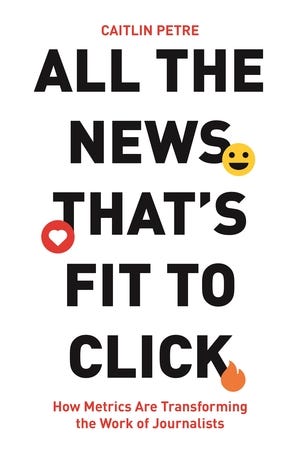
I’m reading All the News That’s Fit to Click (2021) by Caitlin Petre, who shadowed, observed and spoke with staff at Gawker and NYT, as well as Chartbeat, to learn about how the news analytics company online journalism. It may be a little dated — for example, Gawker, having been sued into oblivion by Peter Thiel, no longer exists — but it provides a foundational understanding on the early days of publisher-centric performance metrics, when other analytics tools such as Google Analytics tend to offer more general analytics, or cater to e-commerce, product or app analytics.
I’m listening to the NASA podcast on the Artemis II mission. This whole event feels like binge-watching a hit streaming show with hundreds of millions of fans and then when it’s over, getting whatever the equivalent of a sub drop is, and then asking Rihanna “new album wen?”
I’m watching Michelle Wong’s on the AI slop produced by science creators. (Keyword here is ‘slop’.)
Chart of the week
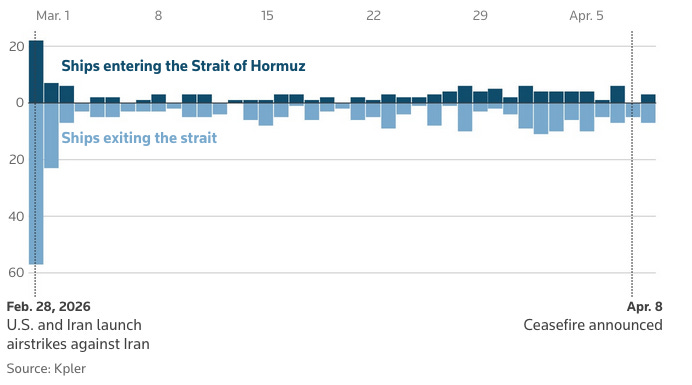
Reuters’s Mariano Zafra and Prasanta Kumar Dutta, with data from Kpler, report just 15 ships had entered or exited the Strait of Hormuz since a ceasefire was announced on April 8.