
The 305th Block: Narcissism
And bubbled influencers, poor PhDs, starving Sudan

This week…
Your reading time is about 5 minutes. Let’s start.
I’m substituting the Wikipedia of the week with an academic paper of the week. I promise it’s a fun one. If you’ve been watching The Pitt and wondering why the surgeon characters are so arrogant — except, surprisingly, the neurosurgeon in the first season with his corny jokes — and whether that’s a fair portrayal, there is a 2024 paper exploring “grandiose narcissism” among surgeons.

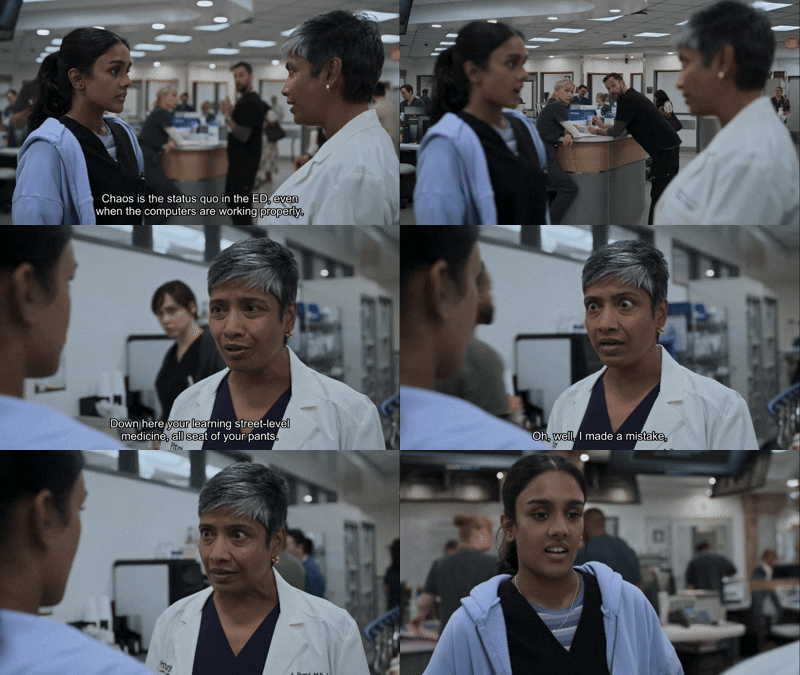
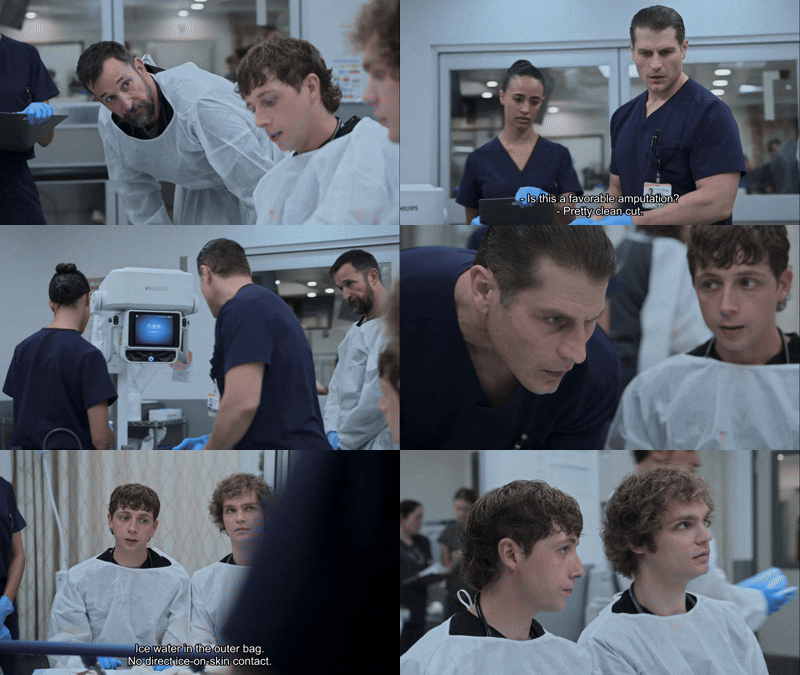
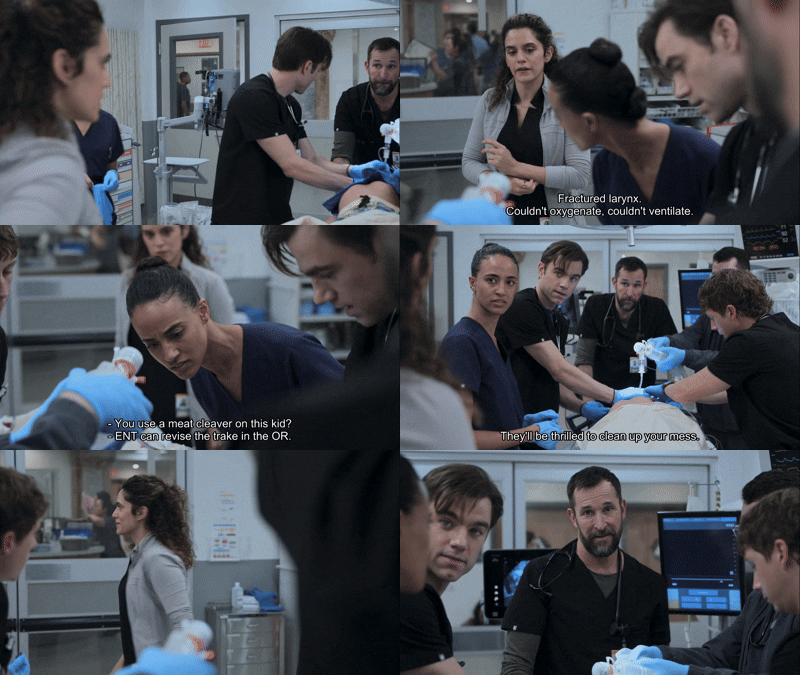
The paper also cited a 2015 study that claimed narcissism is more common in surgey than in other health care disciplines. Anyway, with everything going on in the world, I don’t know if narcisists fictional surgeons are my biggest concerns. :)
But, also! Importantly! There are several scholars writing papers in defence of narcissism — and you know what, I can get behind some of these arguments, except for the special kind of American-centred narcissism.
Your paper this week: Moellmann, H.L., Rana, M., Daseking, M. et al. Exploring grandiose narcissism among surgeons: a comparative analysis. Sci Rep 14, 11665 (2024). https://doi.org/10.1038/s41598-024-62241-6
And now, a selection of top stories on my radar, a few personal recommendations, and the chart of the week.
ICYMI: The Previous Block was about war and everything.
CORRECTION NOTICE: None notified.DISINFORMATION, MEDIA & JOURNALISM
The influencer bubble: Can content creators continue to airbrush the Gulf?
Irina Matchavariani for Coda:
Julia E, an 18-year-old influencer from Germany, was hanging out with her family on the Palm Jumeirah beach when she heard a blast and saw a fireball erupt into the sky. She knew tension was mounting following the U.S.-Israeli attack on Iran the previous day, but she didn’t imagine Dubai would be on the frontline. “I was a little scared,” she says. “Usually you just read about it in the newspapers, you see it online, but when you see it in front of you, it’s a different feeling — like your heart just drops.”
The fear was not an emotion she expressed on Instagram. Julia’s family moved to Dubai from Germany in 2024, tempted by the business potential of an emirate that aggressively marketed itself as the influencer capital of the world — a digital utopia carved out of the desert, with its gleaming skyscrapers and Insta-ready waterfronts. Dubai’s state-backed Creator HQ offers content creators long-term residencies, legal support, networking opportunities, training and an environment geared towards digital entrepreneurship. Influencers need a permit to legally operate in Dubai but taxes are negligible — 5% VAT on taxable income from clients in the UAE over AED 375,000 (about $102,000), and a flat 9% corporate tax on income exceeding AED 1,000,000 (about $272,000). It has attracted over 50,000 content creators to Dubai, which has a population of about 4 million.
With 60,000 followers on TikTok and Instagram, Julia is looking to build her own marketing company in Dubai. In an effort, she says, to comfort her younger brother, she recorded a video shortly after witnessing the explosion. It showed Julia, a palm tree and the glittering night skyline behind her, with the caption: “You live in Dubai, aren’t you scared?” The video cuts to a montage of Mohamed bin Zayed Al Nahyan and other Emirati sheikhs: “No, because I know who protects us.” The short video is set to a stirring rendition of the Belgian singer Stromae’s ‘Papaoutai’, a song that laments the loss of a father.
Loosely linked:
For Latin America’s journalism students, news starts on Instagram by César López Linares for LJR. Not in Canada. Thanks, Zuck.
The Netherlands’ largest newspaper, De Telegraaf published a story with AI to promote non-existent evacuations from the Middle East by Foeke Postma for Bellingcat. Four days later, the photos were removed from the article.
The great broadcasting retreat by Dalia Parete for Lingua Sinica. China is shutting down hundreds of local TV and radio channels and rebuilding its propaganda apparatus online.
La fascinante vida de la condesa que se enfrentó al nazismo y sobrevivió para convertirse en referente del periodismo por Andrea Blez en elDiario.es.
« Jusqu’à 80 directs par jour » : Siavosh Ghazi, la voix des médias francophones depuis Téhéran par Romain Chauvet dans La revue des médias.
DATA, AI & BIG TECH
Laid-off lawyers, PhDs, and scientists are teaching AI to do their old jobs
Josh Dzieza with art by Samar Haddad for The Verge :
The LinkedIn post seemed like yet another scam job offer, but Katya was desperate enough to click. After college, she’d struggled to make a living as a freelance journalist, gone to grad school, then pivoted to what she hoped would be a more stable career in content marketing — only to find AI had automated much of the work. This company was called Crossing Hurdles, and it promised copywriting jobs starting at $45 per hour.
Katya clicked and was taken to a page for another company, called Mercor, where she was instructed to interview on-camera with an AI named Melvin. “It just seemed like the sketchiest thing in the world,” Katya says. She closed the tab. But a few weeks later, still unemployed, she got a message inviting her to apply to Mercor. This time, she looked up the company. Mercor, it seemed, sold data to train AI, and she was being recruited to create that data. “My job is gone because of ChatGPT, and I was being invited to train the model to do the worst version of it imaginable,” she says. The idea depressed her. But her financial situation was increasingly dire, and she had to find a new place to live in a hurry, so she turned on her webcam and said “hello” to Melvin.
Loosely linked:
Big Tech competition risks trampling over human rights in Africa by Mark Briggs for LSE Blogs. The business model of large tech companies makes competition between them fiercer and so reduces the incentives for them to care about staff or user wellbeing, unless policy forces them.
These aren’t AI firms, they’re defense contractors. We can’t let them hide behind their models by Avner Gvaryahu for The Guardian. From Gaza to Iran, the pattern is the same: precision weapons, chosen blindness, and dead children. The cost of failing to regulate AI warfare is already too high.
La IA puede devorar miles de artículos científicos pero es incapaz de comprender la ciencia que explica por Héctor Farrés en elDiario.es.
Faux sites, “boules puantes”, programmes aseptisés... Comment l’intelligence artificielle parasite la campagne des élections municipales par Laure Cometti dans Franceinfo.
DEMOCRACY, RIGHTS & REGULATION
Images show longterm ‘starvation strategy’ in Sudan
Kaamil Ahmed and Alex Clark for The Guardian:
There is strong evidence that the Rapid Support Forces (RSF) committed a war crime by depriving the villagers of north Darfur of the means to produce food, legal experts argue in a new analysis calling for the Humanitarian Research Lab’s (HRL) revelations to be used in international courts.
The destruction of the villages, farming equipment and infrastructure all provide strong evidence of a “starvation strategy” against a population already struggling with food insecurity because of the war, says Tom Dannenbaum, a professor at Stanford Law School and a leading expert on the use of starvation in war.
“People were at the brink of starvation and objects indispensable to their survival were being destroyed,” says Dannenbaum, who co-authored the analysis alongside Yale Law School professor Oona Hathaway.
He says it was not merely the fact the villages had been attacked but the targeted destruction of livestock enclosures, as well as the forced displacement of the farmers, that led to reduced farming activity that suggested a deliberate attempt to prevent the villages from being able to produce food.
Loosely linked:
African nations tiptoe around recruitment of citizens by Russian networks
David Lewis and Tim Cocks for Reuters. Reports in recent weeks revealed the scope and scale of the recruitment of Africans into Russia's depleted forces, often via third parties offering lucrative civilian jobs, triggering anger in countries like Kenya, Ghana and South Africa.
The limits of the International Court of Justice in the Thailand-Cambodia dispute By Blanche de Brondeau for The MIR.
Kast instala su residencia en el ala de La Moneda donde Allende se quitó la vida hace 52 años por Pedro Schwarze en El País.
Blanche pour tous par Julie Landry, photographies par Alexandre Lamic et
Geneviève Lasalle dans Radio-Canada.
What I read, listen, and watch

I’m reading Frankissstein (2019) by Jeanette Winterson. I’m recognising that I enjoy spec fic, but I sometimes have trouble following a book when they switch between multiple timeline/periods and narratives. It’s about transgender and transhumanist issues and the ethicial philosophies that Mary Shelley explored in her 1818 class Frankenstein, that’s all I can say with confidence.
I’m listening to the 404 Media podcast on Roblox’s grooming problem with Cecilia D’Anstasio from Bloomberg.
I’m watching how hactivist Martha Root shut down white supremacist websites.
Chart of the week
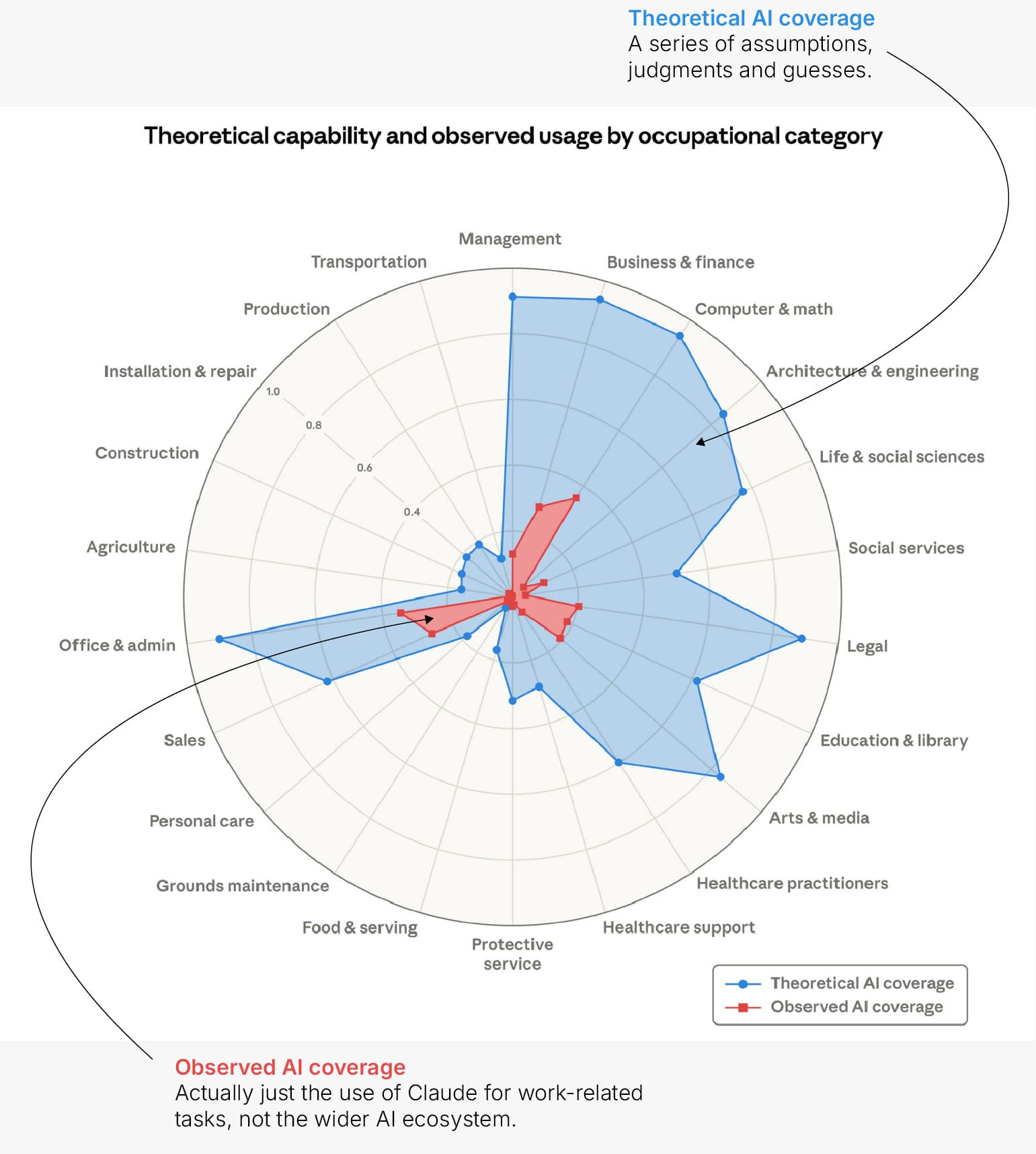
Not-Ship’s Amanda Shendruk showed that AI job predictions are just “hunches dressed up like facts.”