
The 303rd Block: Ignorance is strength
- INGSOC.

This week…
Your reading time is about 5 minutes. Let’s start.
War is crazy, guys, I don’t know what else to tell you. I used up all my words writing my 2,500-word final assignment and I’m free from contract law for a bit. (I’m also enrolled in evidence law.)
Your Wikipedia this week: Strategy of tension
And now, a selection of top stories on my radar, a few personal recommendations, and the chart of the week.
ICYMI: The Previous Block was about “secure, trustworthy and robust AI.”
CORRECTION NOTICE: None notified. DISINFORMATION, MEDIA & JOURNALISM
First, they came for the journalists
Isobel Cockerell for Coda:
Hundreds of journalists are forced into exile each year, from every corner of the world. As authoritarianism and censorship rise, reporters are among the first to feel the pressure — pushed out of their homes and separated from the careers, sources and communities they’ve built. The number of journalists forced into exile is rising. In Latin America alone, more than 900 journalists were forced into exile between 2018 and 2024. Almost half of the journalists killed around the world last year were by Israeli forces in Gaza; the tally is close to 300 for the duration of the war. The genocide created impossible conditions for Palestinian journalists, forcing some to flee the Gaza strip entirely.
In a digitized, connected world, exile doesn’t mean silence. Using open source intelligence techniques, encrypted messaging, and data, journalists can report in real time from thousands of miles away, serving communities they can no longer reach in person.
We spoke to four journalists from four countries who have spent the past decade working in exile. Some left gradually, step by step. Others had only hours to abandon their lives. Every year, hundreds more join them — barred from returning home, facing imprisonment or persecution if they do, uncertain when or whether they’ll see their families again.
Still, they keep reporting. These are their stories.
Loosely linked:
The voice of the Uyghur Post by Liam Scott for CJR.
Hong Kong tycoon Jimmy Lai wins appeal against fraud conviction by Koh Ewe and Danny Vincent for BBC.
Costa Rica elimina el arresto por difamación, pero expertos dicen que la reforma queda corta por Silvia Higuera en LJR..
Les fausses publications scientifiques menacent de submerger la recherche contre le cancer par Baptiste Scancar et David Causeur (Université de Rennes) dans The Conversation.
DATA, AI & BIG TECH
Why is AI so bad at reading PDFs?
Josh Dzieza for The Verge:
PDFs are notoriously difficult for machines to parse, in part, because they were never meant to be read by them. The format was developed by Adobe in the early 1990s as a way to reproduce documents while preserving their precise visual appearance, first when printing them on paper, then later when depicting them on a screen. Where formats like HTML represent text in logical order, PDF consists of character codes, coordinates, and other instructions for painting an image of a page.
Optical character recognition (OCR) can turn those pictures of words back into text computers can use, but if it comes across a PDF where text is displayed in multiple columns — as many academic papers are — it will plow ahead left to right and create an unintelligible jumble. OCR tools are designed to detect and correct for these sorts of formatting variations, but tables, images, diagrams, captions, footnotes, and headers all present further obstacles. If you give an AI assistant like ChatGPT a PDF, it will cycle through a variety of these tools, sometimes fail, sometimes pass the PDF to a large vision model to perform OCR, sometimes hallucinate, and generally take a very long time and use a lot of computing power for uneven results.
“The key issue is that they cannot recognize editorial structure,” said Pierre-Carl Langlais. “It’s all fine while it’s relatively simple text, but then you’ve got all these tables, you’ve got forms. A PDF is part of some kind of textual culture with norms that it needs to understand.”
Loosely linked:
The AI videos supercharging Russia’s online disinformation campaigns by Daria Mosolova for BBC.
How AI resurrects racist stereotypes and disinformation — and why fact‑checking isn’t enough by Nadiya N. Ali (Trent University) for The Conversation.
Pasiones tristes al servicio del capital y el fascismo (o el porqué del odio en redes) por Nuria Alabao en CTXT.
Quatre ans de guerre en Ukraine : sur Wikipédia, une lutte acharnée pour contrer la propagande russe par Noémie Lair dans Franceinfo.
DEMOCRACY, RIGHTS & REGULATION
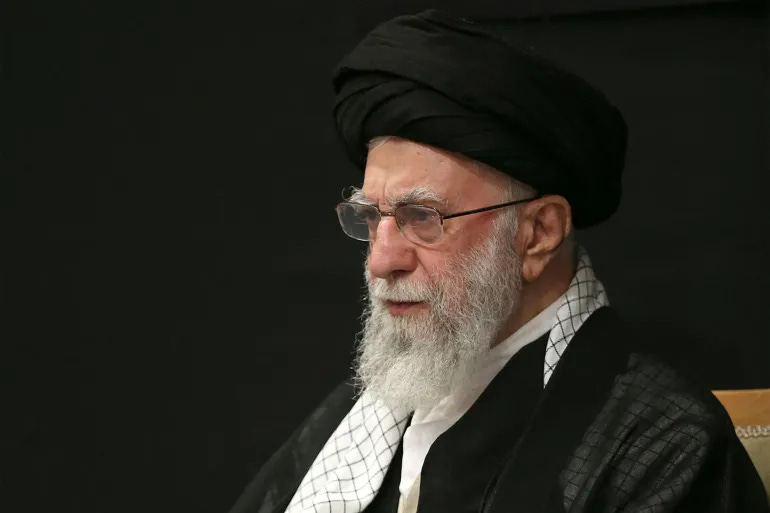
Ayatollah Ali Khamenei: The leader who shaped Iran’s defiance
Virginia Pietromarchi for Al Jazeera:
IKhamenei took the helm in Iran in 1989, following the death of Ayatollah Ruhollah Khomeini, the charismatic leader who had spearheaded the Islamic revolution a decade earlier.
While Khomeini was the ideological force behind the revolution that ended the rule of the Pahlavi monarchy, it was Khamenei who shaped the military and paramilitary apparatus that forms both Iran’s defence against its enemies and provides it with influence well beyond its borders.
Before becoming the supreme leader, he had led Iran as president through a bloody war with Iraq in the 1980s. The grinding conflict, coupled with a sense of isolation among many Iranians as Western countries backed Iraqi leader Saddam Hussein, deepened Khamenei’s distrust of the West, generally, and the US, in particular, analysts say.
That sentiment would underpin his decades-long rule and cement the idea that Iran must remain in a constant state of defence against external and internal threats.
Loosely linked:
Gig workers in Africa have been helping the US military. They had no idea by
Niamh McIntyre, Edwin Okoth and Cam Wilson for TBIJ and Rest of World.
Kashmir, spying, demolitions: How Modi’s India embraced ‘Israel model’ by Yashraj Sharma for Al Jazeera.
The politics of wildlife protection by Sam Meadows for New Lines Magazine.
Lo que habremos hecho. A cincuenta años del último golpe de Estado en Argentina por Darío Adanti en elDiario.es.
Les droites radicales mettent la crise climatique au service d’un discours raciste par Emilie Echaroux dans Usbek & Rica.
What I read, listen, and watch
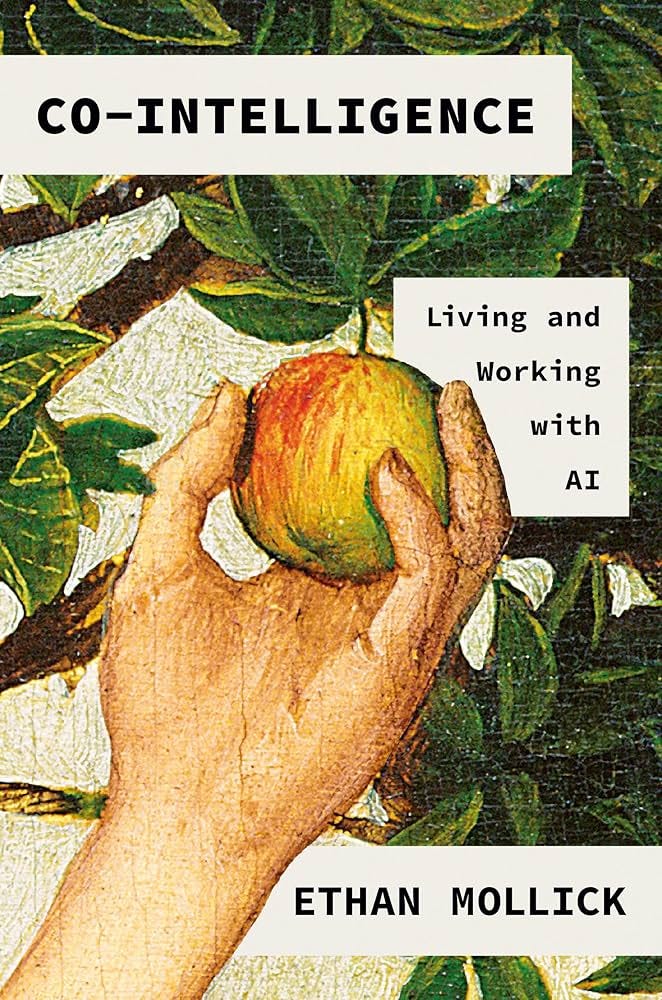
I’m reading Co-Intelligence: Living and Working with AI (2024) by Ethan Mollick. I won’t lie, this was a little underwhelming for me because it feels quite surface-level, and using too much redundant generative AI assistance (in a demonstrative, non-ironic way). But maybe it’s not for me! If you’ve been following my reading journey you know I read too many books on AI.
I’m listening to Nature Podcast brief on how Pokémon inspired generations of researchers. 🥹 (Happy 30th!)
I’m watching a Bloomberg investigation on the making of a Chinese spy. (It’s bad.)
Chart of the week
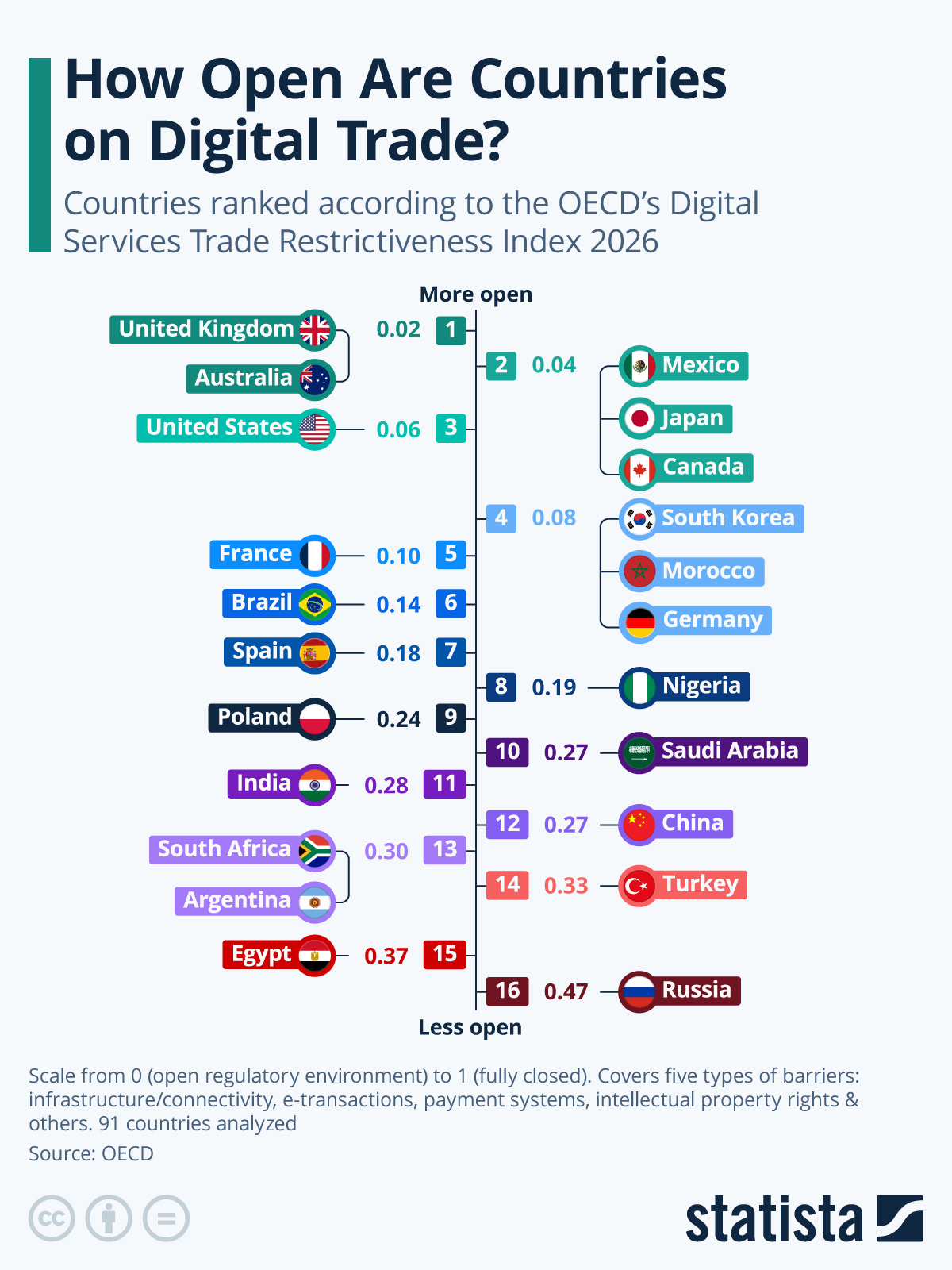
The OECD’s Digital Services Trade Restrictiveness Index 2026 reveals a sharp contrast in how countries regulate digital trade. Tristan Gaudiaut wrote a summary for Statista. Coincidently, I’m in the midst of writing a paper on the accessibility and effectiveness of remedies for breaching digital contract laws in the UK.