
The 291st Block: Chat is 3
Meanwhile I'm still struggling to stop receiving AI-generated music recommendations

This week…
Your reading time is about 5 minutes. Let’s start.
ChatGPT turns three today. On November 30, 2022, OpenAI launched the AI chatbot, attracting more than 700 millions of weekly users to get everyday tasks done. The latest version, GPT-5.1, released on November 12, is “warmer, more intelligent, and better at following instructions.”
Your Wikipedia this week: Roko’s basilisk
And now, a selection of top stories on my radar, a few personal recommendations, and the chart of the week.
ICYMI: The Previous Block was about AI media, propaganda, and the climate.
CORRECTION NOTICE: None notified. NEWS INFLUENCERS
Brazilian creators are redefining the relationship between journalists and newsrooms
Marta Szpacenkopf for LJR:
The news industry is scrambling to figure out how to define, understand and replicate the success of content creators and influencers in attracting and informing audiences on social media.
Scholars are researching how they operate, news organizations are looking to collaborate or compete, and some journalists are even leaving the newsroom to strike out on their own.
One of the countries feeling the impact of these new players on the news industry most intensely is Brazil. And the numbers show it.
When looking for news, social media users are turning to creators and influencers more than traditional media brands and journalists, according to a recent study from the Reuters Institute for the Study of Journalism.
The data show that 33% of Brazilian respondents say they follow creators and influencers to stay informed, while 30% say they follow news brands and journalists.
“While news creators and influencers draw considerable attention in countries like Mexico and Colombia, Brazil is the only Latin American country in our analysis where survey respondents say they pay more attention to individual creators and personalities for news on social media,” Amy Ross Arguedas, one of the study authors, told LatAm Journalism Review (LJR).
Loosely linked:
News influencers are reshaping the media – insights from Kenya, Nigeria and South Africa by Amy Ross Arguedas and Nic Newman (University of Oxford) for The Conversation.
China requires influencers to prove credentials to give expert advice ($) by Tim Bajarin for Forbes.
Many prominent MAGA influencers on X are based outside US, new tool reveals by Marina Dunbar for The Guardian.
Foreign interference or opportunistic grifting: why are so many pro-Trump X accounts based in Asia? by Jonathan Yerushalmy for The Guardian.
How big tech is creating its own friendly media bubble to ‘win the narrative battle online’ by Nick Robins-Early for The Guardian.
MANOSPHERE
Sun, cigars, and sexism: How Spain’s Marbella became a hotspot for ‘manosphere’ influencers
Mayya Chernobylskaya, Polina Bachlakova, Apolena Rychlíková, Kristina Böhmer, and Vânia Maia for OCCRP:
Through tracking social media connections, business ventures, and public and private events, reporters found the sun-drenched city on Spain’s Costa del Sol — famed as a haunt for celebrities, oligarchs, and organized crime — has become a magnet for male influencers and self-described entrepreneurs, including some from the Tates’ personal and professional circle.
Some in this community are regular visitors to Marbella, while others have fully relocated there. As well as featuring in each other’s online content, including interviewing each other for podcasts and videos, they network together in real life at social and business events. Some have openly expressed misogynistic views; others have given a platform to those who express them. They use Marbella and its reputation for glamour and wealth to enhance their personal brands.
“It’s no coincidence this is happening in a place like Marbella, where economic status and displays of power form the backbone of social relations,” said Spain-based social psychologist Jesús Moreno, who is head of social participation at Fundación Iniciativa Social in Seville, the capital of the Andalusia region which includes Marbella. The organization focuses on gender equality, among other social issues.
Moreno pointed out that while all-male social communities are nothing new, from hunting groups to sports clubs, the danger here is that they will embolden the manosphere’s already toxic views.
“These interactions risk hardening into sect-like dynamics that continually reinforce their misogynistic and anti-feminist narratives,” he said.
Loosely linked:
The anatomy of hate: How misogyny drives extremist engagement by Cynthia Miller-Idriss for The Interpreter.
The rise of the ‘performative male:’ How young men are experimenting with masculinity online by Jillian Sunderland (University of Toronto) for The Conversation.
The use of fundamentalist sexual narratives to legitimise incel ideology by Erin Stoner for GNET.
Intersectionality in the incelosphere by Ryan Ratnam for GNET.
Other curious links, including en español et français
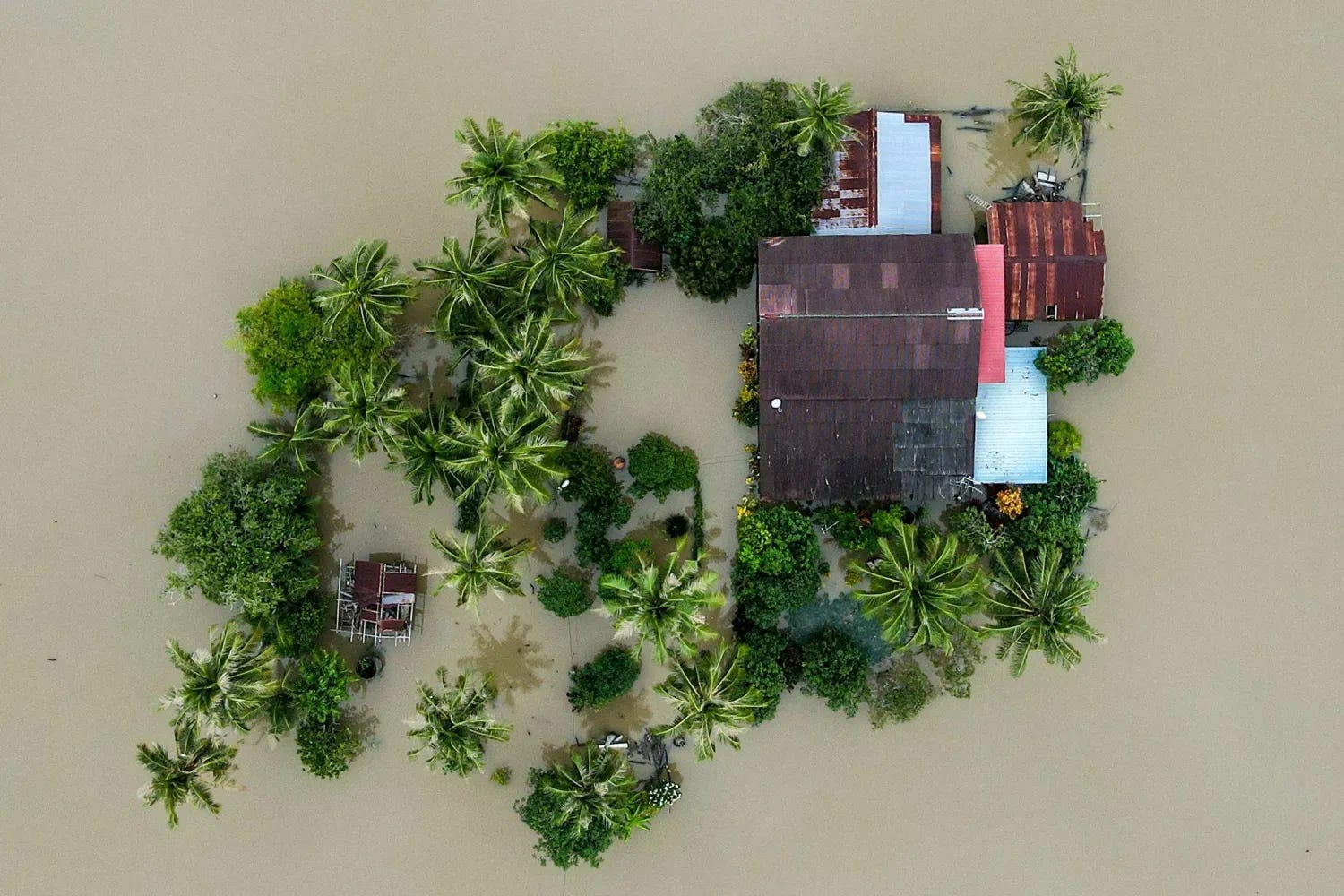
LONG READ | The digital exiles: Why people are abandoning their smartphones by Isobel Cockerell for Coda.
INFOGRAPHIC | How the deadly Hong Kong inferno spread by Adolfo Arranz, Jitesh Chowdhury, Han Huang, Sudev Kiyada, Farah Master, and Kosato Nakhro for Reuters.
PHOTO ESSAY | The offices only a newsperson could love ($) by Zach Helfand for The New Yorker.
El cas de las estatinas (o còmo intenté dejar de preocuparme por el colesterol) por Mónica Yemayel en Gatopardo.
Evangélicos en el palacio y la calle por Marina Amabile en Anfibia.
Días en el desierto para conseguir embarcar en una patera: el otro lado de la caída de llegadas irregulares a Canarias por Ngone Ndiaye en elDiario.es.
Mères en cavale, justice aveugle : Romane Brisard raconte son enquête sur l’inceste par François Quinton dans La revue des médias.
« Où qu’on se tourne, la porte se ferme », s’attristent des étudiantes voilées par Fannie Bussières McNicoll dans Radio-Canada.
Québec brut[aliste] par Marie-Christine Gagnon et Olivia Laperrière-Roy dans Radio-Canada.
What I read, listen, and watch
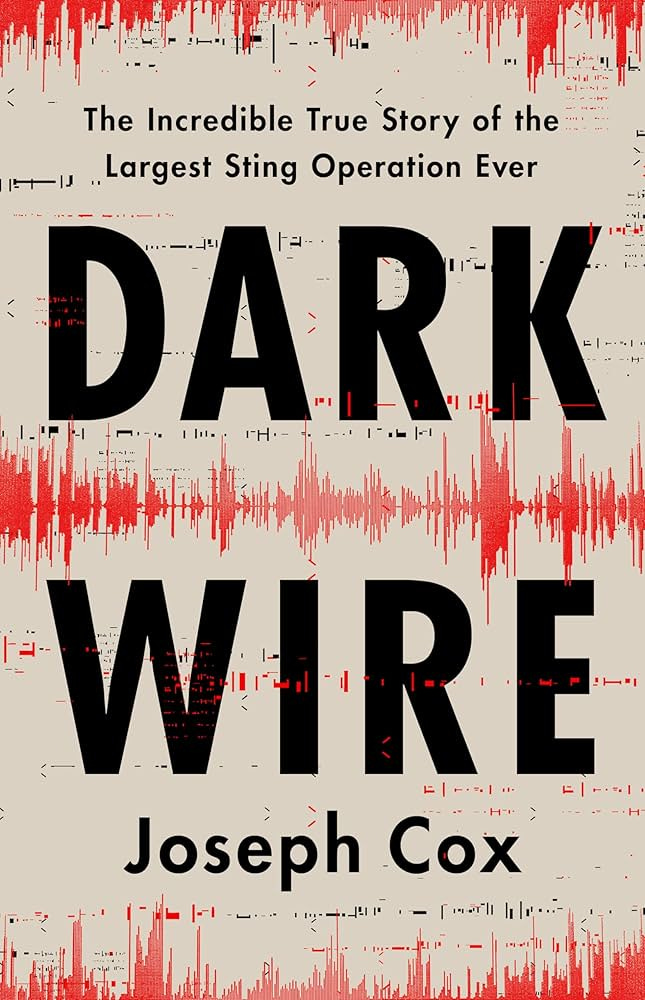
I’m reading Dark Wire (2024) by Joseph Cox, about the sting operation using the ‘secure’ communications app Anom to wiretap the organised crime world.
I’m listening to Tech Won’t Save Us about how data centres fuel consumption of more oil and gas.
I’m watching The Thinking Game (2024), dir. Greg Kohs, a documentary into the heart of DeepMind, filmed by the team behind AlphaGo (2017).
Chart of the week
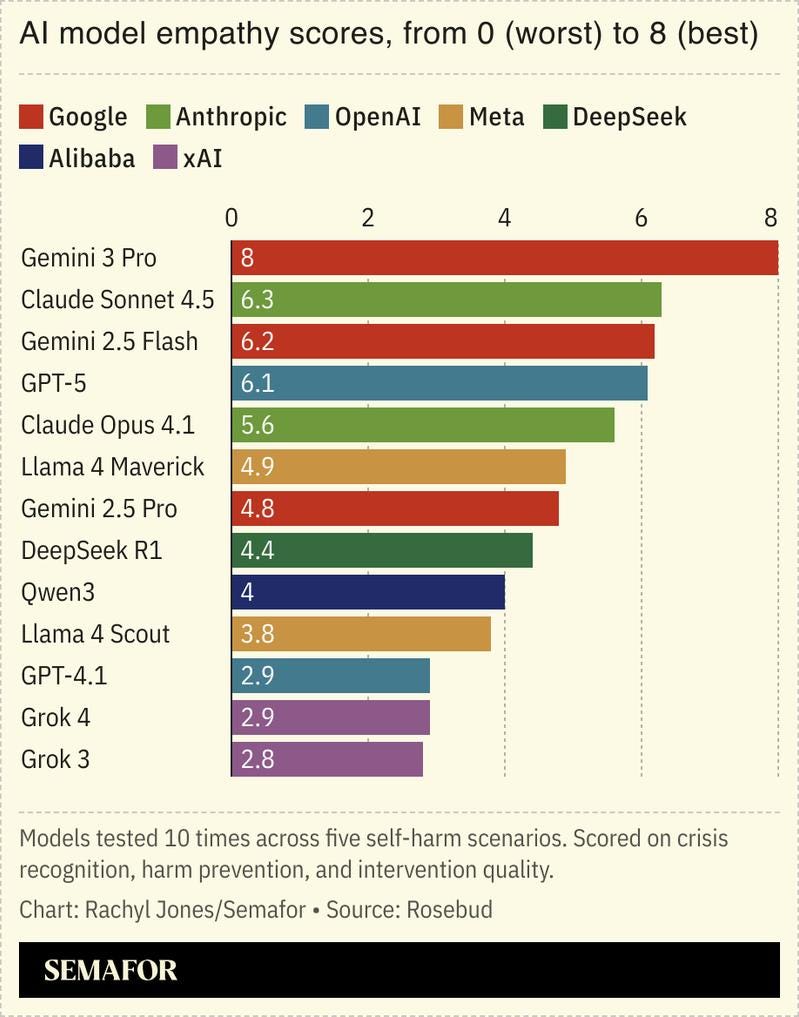
Gemini is most ‘empathetic’ AI model, according to Semafor’s Rachyl Jones’ test using AI journaling app Rosebud.